Hank of SciShow talks about space debris and possible ways to reduce it:
Background materials can be found at SciShow 2 April 2013 References – Google Drive
The latest presentation to the Future In-Space Operations (FISO) study group is now posted in the FISO Working Group Presentations Archive. Both slides (pdf) and audio (mp3) are available for the talk, Skylab II, Making a Deep Space Habitat from a Space Launch System Propellant Tank – Brand Griffin, Gray Research – Mar.27.2013
Rushing headlong hand in hand with NASA into the past, Mr. Griffin wants to use NASA’s revived Saturn V to build a revised Skylab space station (though, in this case, for deep space rather than for LEO):
Note that Mr. Griffin compares the cost of a Delta IV to the fairy tale $500M cost for the SLS. This number comes from NASA’s absurd use of fantasy marginal cost estimates when asked for the cost of its launch vehicle missions.
Say the SLS program averages one to two flights per year. If the cost is $3B per in the years with one launch and $3.5B in the years with two launches then NASA will claim that a SLS flight costs $500M (i.e. the marginal cost, which is the cost to produce one more unit output). This is obviously ridiculous. The meaningful cost is $6.5B/3 = $2.17B per flight. For low production numbers, it is only the average cost that is significant, not marginal cost. (Usually NASA just guesses how much one more flight would cost but I used this year to year comparison to make the marginal cost more explicit.)
Of course, unlike normal enterprises, the development cost of the SLS, which will be around $20B for the initial 70mT version, should also be spread over the launches but NASA ignores development costs just like it ignores annual infrastructure/fixed costs.
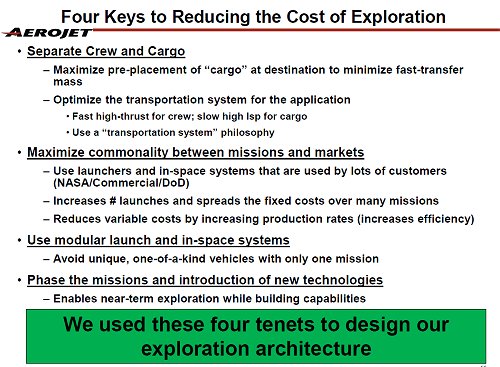
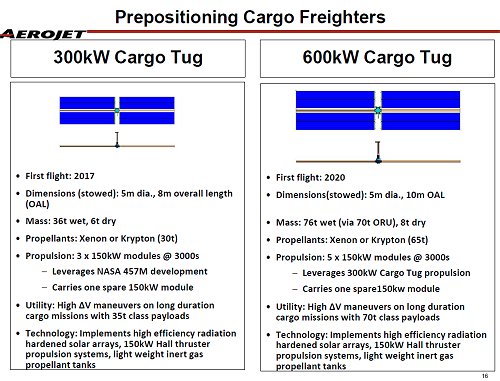
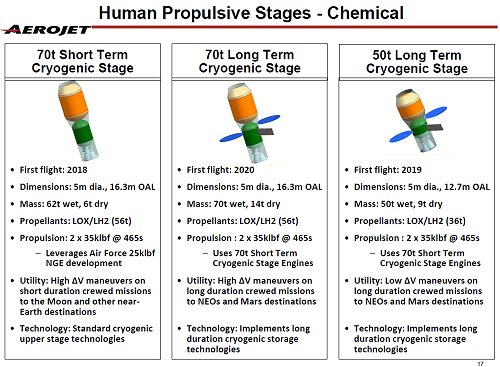
The latest presentation to the Future In-Space Operations (FISO) study group is now posted in the FISO Working Group Presentations Archive. Both slides (pdf) and audio (mp3) are available for the talk, Reducing the Cost of Exploration using Near-Term Advanced In-Space Propulsion – Roger Myers, Aerojet – March 13, 2013.
A key part of the proposal is to use slow but highly efficient solar electric propulsion (SEP) systems for cargo and faster but a lot less efficient high thrust chemical (e.g. LOX/LH2) propulsion for crews.
The latest presentation to the Future In-Space Operations (FISO) study group is now posted in the FISO Working Group Presentations Archive. Both slides (pdf) and audio (mp3) are available for the talk, Combined SEP-Chemical for Piloted Mars Missions, Steve Oleson , NASA GRC – March 6, 2013.
Unfortunately, all the plans he discusses rely on the SLS vehicle, which will cost billions to fly and so there will be no funding left for projects like this.

Alan Boyle writes about the possibility that Comet 2013 A1 (aka Comet Siding Spring) might hit Mars and how this might affect attitudes on earth about the threat of comet and asteroid impacts on earth: ‘Marsageddon’ comet scenario adds to concerns about threats from space – Cosmic Log.
He also discusses the writeup – Warning Shots – Space Access Update #130 – 3/4/13, by Henry Vanderbilt of the Space Access Society, on whether we could prevent such a cometary hit if we only had two years of warning.
===
Michale Belfiore points to the 2013 IAA Planetary Defense Conference, 15-19 April, 2013 in Flagstaff, Arizona, USA, where such issues will be discussed: Planetary Defense Conference 2013 – Michael Belfiore.