Category Archives: In Space Infrastructure

FISO: Defending the earth from asteroids – Bill Ailor of Aerospace Corp.

The latest presentation to the Future In-Space Operations (FISO) study group is now posted in the FISO Working Group Presentations Archive. Both slides and videos (zip) and audio (mp3) are available for the talk, Defending the Earth From Asteroids: Meeting the Challenges of Planetary Defense, by Bill Ailor of Aerospace Corp, March 12, 2014.

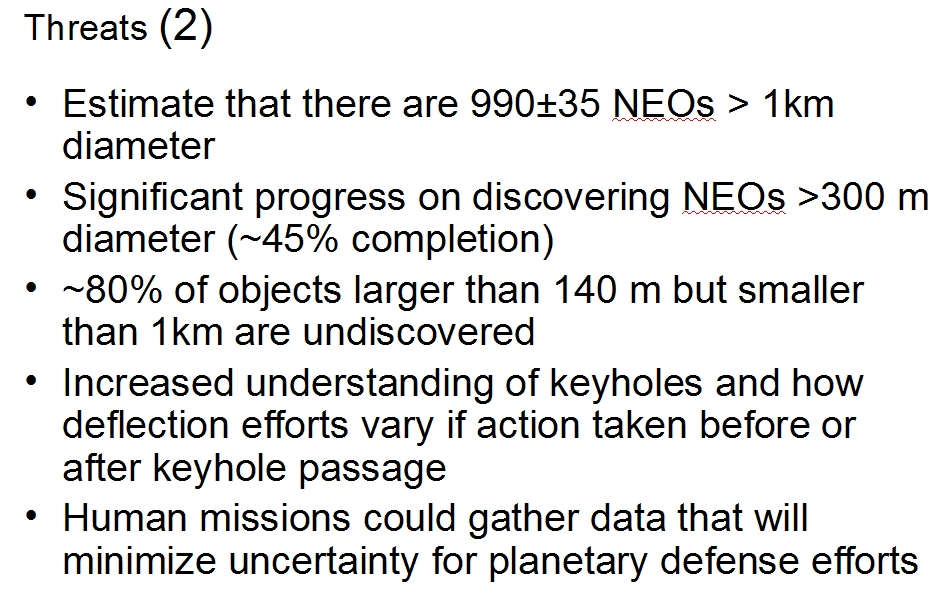
Ailor reviews what’s known about the asteroids and near earth objects, their threats to earth, how a NEO threat could be diverted, and legal/policy issues.

A sample of his slides:

SizesTable

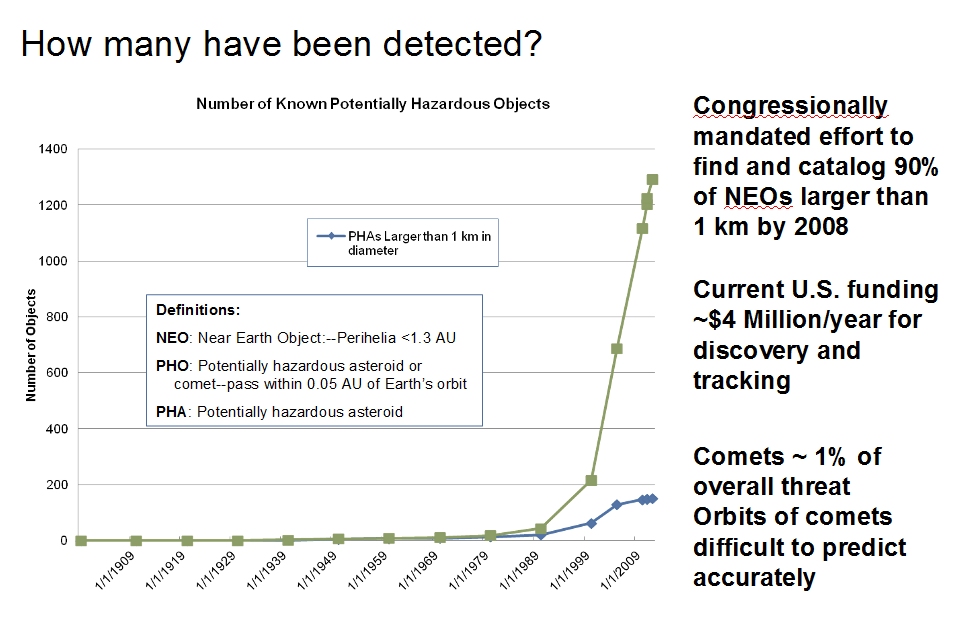
HowManyDetected

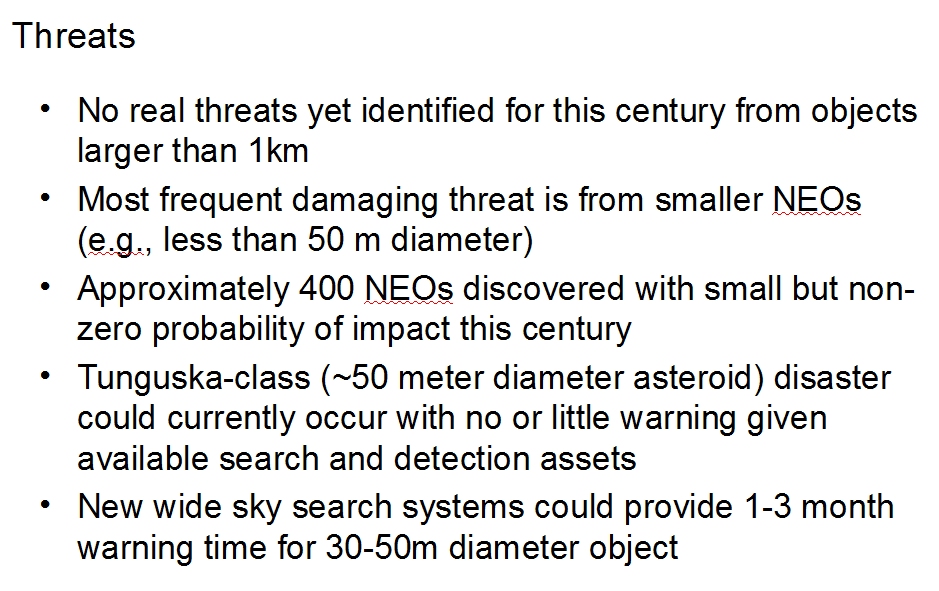
Threats

Threats2


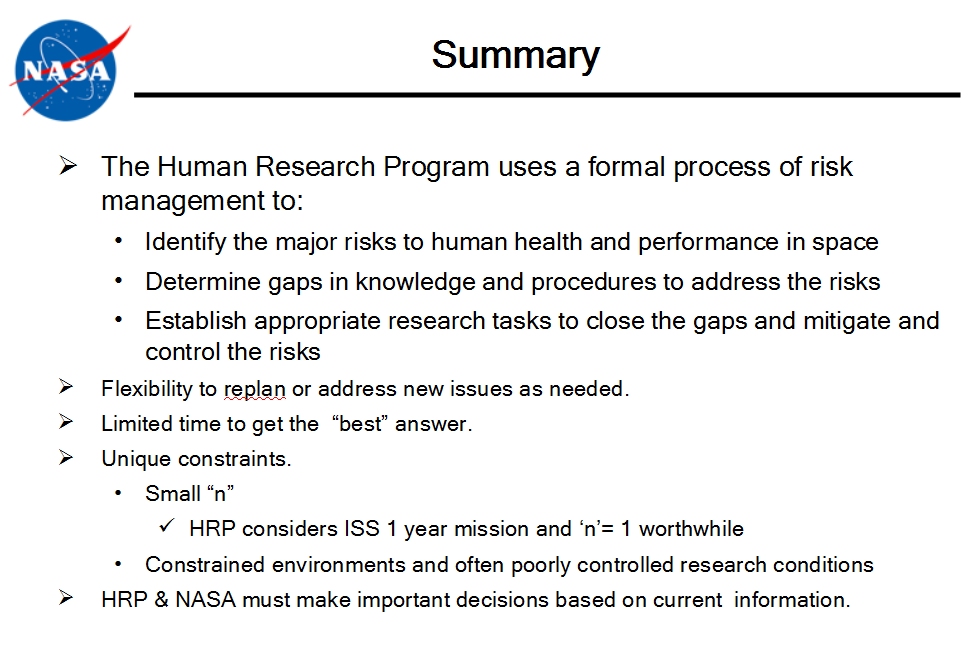
Summary


Video: NASA’s “Space to Ground” update on the ISS

The latest video report on activities aboard the Int. Space Station in the past week:

FISO: Overview of the Affording Mars workshop

The latest presentation to the Future In-Space Operations (FISO) study group is now posted in the FISO Working Group Presentations Archive. Both slides (pdf) and audio (mp3) are available for the talk, Affording Mars – a Workshop, a Plan, a Future Course for Human Spaceflight, Michael Raftery (Boeing) & Joseph Cassady (Aerojet) – Feb.19.14

This is an overview of the Affording Mars Workshop held last December in Washington, DC. , which was organized by the Explore Mars group.

Their Mars mission architectures used the exorbitantly expensive SLS/Orion systems and did not employ any innovative low-cost approach like Mars Direct. Other than employing the ISS in preparations more extensively, their program design doesn’t seem much different than previous Mars plans at NASA. Yet they claim to have shown that human Mars exploration can be affordable. That is, they are claiming that doing the same thing yet again and expecting a different result was not insane this time.

Books: “The Case for Space Solar Power” + “Space Elevators: An Assessment”

Former NASA manager and long time proponent of space based solar power, John C. Mankins has published a new book on the topic: The Case for Space Solar Power (available in both hardback and kindle versions).

The National Space Society, not suprisingly, likes it: New Book: The Case for Space Solar Power – NSS Blog

A strong case for harnessing space solar power is presented in this ground-breaking new book. Author John C. Mankins, one of the foremost experts in the field, presents his latest research in The Case for Space Solar Power.

The Case for Space Solar Power recounts the history of the space solar power concept and summarizes the many different ways in which it might be accomplished.

Specifically, the book describes in detail a highly promising concept — SPS-ALPHA (Solar Power Satellite by means of Arbitrarily Large Phased Array) — and presents a business case comprising applications in space and markets on Earth. It is possible to begin now with technologies that are already at hand , while developing the more advanced technologies that will be needed to deliver power economically to markets on Earth.

The Case for Space Solar Power lays out a path forward that is both achievable and affordable. Within a dozen years, the first multi-megawatt solar pilot plant could be in operation.


===

The International Academy of Astronautics (IAA) has examined another ambitious space technology and found it to be feasible and promising: Space Elevators: An Assessment of the Technological Feasibility and the Way ForwardSee also


ESA e.DeOrbit mission would capture and deorbit a derelict satellite

Here’s an item from ESA about an initiative to clean up space debris:

How to catch a satellite 

21 February 2014: Standard space dockings are difficult enough, but a future ESA mission plans to capture derelict satellites adrift in orbit. Part of an effort to control space debris, the shopping list of new technologies this ambitious mission requires is set for discussion with industry experts.

ESA’s Clean Space initiative is studying the e.DeOrbit mission for removing debris, aiming to reduce the environmental impact of the space industry on Earth and space alike.


Netting a derelict satellite

Earth’s debris halo

Decades of launches have left Earth surrounded by a halo of space junk: more than 17 000 trackable objects larger than a coffee cup, which threaten working missions with catastrophic collision. Even a 1 cm nut could hit with the force of a hand grenade.

The only way to control the debris population across key low orbits is to remove large items such as derelict satellites and launcher upper stages.

Such uncontrolled multi-tonne items are not only collision risks but also time bombs: they risk exploding due to leftover fuel or partially charged batteries heated up by orbital sunlight.

The resulting debris clouds would make these vital orbits much more hazardous and expensive to use, and follow-on collisions may eventually trigger a chain reaction of break-ups.

Distribution of debris objects larger than 10 centimetres in space
Distribution of space debris

Targeting key orbits

e.DeOrbit is designed to target debris items in well-trafficked polar orbits, between 800 km to 1000 km altitude. At around 1600 kg, e.DeOrbit will be launched on ESA’s Vega rocket.

The first technical challenge the mission will face is to capture a massive, drifting object left in an uncertain state, which may well be tumbling rapidly. Sophisticated imaging sensors and advanced autonomous control will be essential, first to assess its condition and then approach it.

Making rendezvous and then steady stationkeeping with the target is hard enough but then comes the really difficult part: how to secure it safely ahead of steering the combined satellite and salvage craft down for a controlled burn-up in the atmosphere?

Several capture mechanisms are being studied in parallel to minimise mission risk. Throw-nets have the advantage of scalability – a large enough net can capture anything, no matter its size and attitude. Tentacles, a clamping mechanism that builds on current berthing and docking mechanisms, could allow the capture of launch adapter rings of various different satellites.

Harpoons work no matter the target’s attitude and shape, and do not require close operations. Robotic arms are another option: results from the DLR German space agency’s forthcoming DEOS orbital servicing mission will be studied with interest.

Strong drivers for the platform design are not only the large amount of propellant required, but also the possible rapid tumbling of the target – only so much spin can be absorbed without the catcher craft itself going out of control.


Grabbing a target

Apart from deorbit options based on flexible and rigid connections, techniques are being considered for raising targets to higher orbits, including tethers and  electric propulsion.

A symposium on 6 May in the Netherlands will cover studies and technology developments related to e.DeOrbit, with ESA and space industry representatives presenting their research and outlining their plans. For further information, or to register, go here.