Category Archives: Astronomy

Videos: Night sky highlights for August 2019

A preview of the night sky this August courtesy of the Hubble Space Telescope Science Institute:

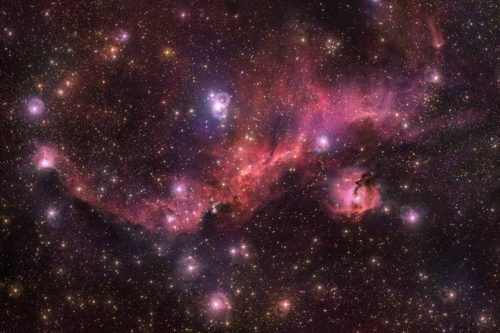
In August, a flock of star-studded figures soars overhead. Look for the Vega and Lyra constellations, which point to Epsilon Lyrae and the Ring Nebula. You can also spot three bright summer stars: Vega, Deneb, and Altair, which form the Summer Triangle. Keep watching for space-based views of these and other stars and nebulas.

** NASA JPL’s What’s Up episode for the coming month:

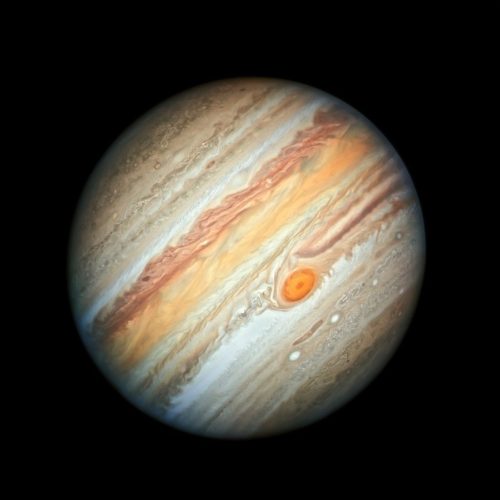
What can you see this month? In the August sky, look for the “shooting stars” of the annual Perseid meteor shower for some stargazing delights, but be warned — the bright Moon will overwhelm the fainter meteors this year. Plus, the Moon’s evening visits to Jupiter and Saturn. Additional information about topics covered in this episode of What’s Up, along with still images from the video, and the video transcript, are available at https://go.nasa.gov/2KijnRU

** Alyn Wallace – What’s in the Night Sky August 2019


If you want to image something in the night sky this month, here is some intro advice: Astrophotgraphy For Beginners: A Complete A-Z Guide (2019).

====

Telescopes and Binoculars at Amazon

Space sciences roundup – Aug.1.2019

A sampling of recent articles, videos, and images from space-related science news items:

** Comets & Asteroids

*** the Comet is a terrific short film created by Christian Stangl who used a good fraction of the thousands of images taken by ESA’s Rosetta mission of the comet Churyumov-Gerasimenko (67p). The music for the soundtrack was composed by Wolfgang Stangl.

*** A sizable  asteroid, previously unknown, flew quite close to earth on July 25th:

From WP:

This asteroid wasn’t one that scientists had long been tracking, and it had seemingly appeared from “out of nowhere,” Michael Brown, a Melbourne-based observational astronomer, told The Washington Post. According to data from NASA, the craggy rock was large, an estimated 57 to 130 meters wide (187 to 427 feet), and moving fast along a path that brought it within about 73,000 kilometers (45,000 miles) of Earth. That’s less than one-fifth of the distance to the moon and what Duffy considers “uncomfortably close.”

Not a country destroyer but it could damage a city if it reached close to the ground:

In 2013, a significantly smaller meteor — about 20 meters (65 feet) across, or the size of a six-story building — broke up over the Russian city of Chelyabinsk and unleashed an intense shock wave that collapsed roofs, shattered windows and left about 1,200 people injured. The last space rock to strike Earth similar in size to Asteroid 2019 OK was more than a century ago, Brown said. That asteroid, known as the Tunguska event, caused an explosion that leveled 2,000 square kilometers (770 square miles) of forest land in Siberia.

*** A flash spotted by weather-sat correlated with a small asteroid detected earlier by a NEO tracking network – NASA Tracked Small Asteroid Before It Broke Up in Atmosphere – NASA JPL

When a lightning detector on a NOAA weather satellite detected something that wasn’t lightning last Saturday, a scientist at the Center for Near Earth Object Studies at NASA’s Jet Propulsion Laboratory in Pasadena, California, did some detective work.

Could a tiny, harmless object that broke up in the atmosphere in a bright flash be connected to a just-received automated alert of a potential near-Earth asteroid discovery? Although far below the size that NASA is tasked to detect and track, the event presented an ideal opportunity for NASA planetary defense teams to test their parts of the alert system.

The outcome? The flow of alert data works, and the culprit was identified: It was an asteroid. Now designated 2019 MO, the asteroid was only about 16 feet (5 meters) in size and was detected at 9:45 UTC (2:45 a.m. PDT, 5:45 a.m. EDT) on Saturday, June 22, by the University of Hawaii’s ATLAS survey telescope on Maunaloa in Hawaii.

** Exoplanets

*** TESS exoplanet observatory off to a good start in its first year in space: TESS Completes 1st Year of Exoplanet Survey, Turns to Northern Sky | NASA

NASA’s Transiting Exoplanet Survey Satellite (TESS) has discovered 21 planets outside our solar system and captured data on other interesting events occurring in the southern sky during its first year of science. TESS has now turned its attention to the Northern Hemisphere to complete the most comprehensive planet-hunting expedition ever undertaken.

TESS began hunting for exoplanets (or worlds orbiting distant stars) in the southern sky in July of 2018, while also collecting data on supernovae, black holes and other phenomena in its line of sight. Along with the planets TESS has discovered, the mission has identified over 850 candidate exoplanets that are waiting for confirmation by ground-based telescopes.

*** TESS spots 3 exoplanets on the small end of the mass spectrum. One is a rocky world a bit bigger than the earth while the other two are about twice as big as earth and classified as gaseous “Mini-Neptunes”. All are in orbits very close to their star: NASA’s TESS Mission Scores ‘Hat Trick’ With 3 New Worlds | NASA

NASA’s newest planet hunter, the Transiting Exoplanet Survey Satellite (TESS), has discovered three new worlds — one slightly larger than Earth and two of a type not found in our solar system — orbiting a nearby star. The planets straddle an observed gap in the sizes of known planets and promise to be among the most curious targets for future studies.

TESS Object of Interest (TOI) 270 is a faint, cool star more commonly identified by its catalog name: UCAC4 191-004642. The M-type dwarf star is about 40% smaller than the Sun in both size and mass, and it has a surface temperature about one-third cooler than the Sun’s. The planetary system lies about 73 light-years away in the southern constellation of Pictor.

 TOI 270 system
This infographic illustrates key features of the TOI 270 system, located about 73 light-years away in the southern constellation Pictor. The three known planets were discovered by NASA’s Transiting Exoplanet Survey Satellite through periodic dips in starlight caused by each orbiting world. Insets show information about the planets, including their relative sizes, and how they compare to Earth. Temperatures given for TOI 270’s planets are equilibrium temperatures, calculated without the warming effects of any possible atmospheres. Credits: NASA’s Goddard Space Flight Center/Scott Wiessinger”. Find more TESS TOI 270 graphics here.

*** TESS found 3 planets in another system and one of the planets is in the star system’s habitable zone : NASA’s TESS Helps Find Intriguing New World | NASA

Tour the GJ 357 system, located 31 light-years away in the constellation Hydra. Astronomers confirming a planet candidate identified by NASA’s Transiting Exoplanet Survey Satellite subsequently found two additional worlds orbiting the star. The outermost planet, GJ 357 d, is especially intriguing to scientists because it receives as much energy from its star as Mars does from the Sun.

“GJ 357 d is located within the outer edge of its star’s habitable zone, where it receives about the same amount of stellar energy from its star as Mars does from the Sun,” said co-author Diana Kossakowski at the Max Planck Institute for Astronomy in Heidelberg, Germany. “If the planet has a dense atmosphere, which will take future studies to determine, it could trap enough heat to warm the planet and allow liquid water on its surface.”

Without an atmosphere, it has an equilibrium temperature of -64 F (-53 C), which would make the planet seem more glacial than habitable. The planet weighs at least 6.1 times Earth’s mass, and orbits the star every 55.7 days at a range about 20% of Earth’s distance from the Sun. The planet’s size and composition are unknown, but a rocky world with this mass would range from about one to two times Earth’s size.

** The Moon

*** Lunar science since Apollo 11 : Astronomer Andrew Fraknoi: 50 Years Since Our First Step held on July 17, 2019 _ Commonwealth Club

July 20, 2019 is the 50th anniversary of humanity’s first steps on the surface of the moon. In that time, the Apollo missions, a fleet of robotic probes and observations from Earth have taught us a lot about Earth’s surprising satellite. In this nontechnical talk, Andrew Fraknoi, who is sometimes called the Bay Area’s public astronomer, will look at the past, present and future of the moon, including its violent origins, the mystery of the frozen water we have found at its poles and its long-term future as it moves farther and farther away from us. Illustrated with beautiful images taken from orbit and on the surface, his talk will make the moon come alive as an eerie world next door, as a changing object in our skies, and as a possible future destination for humanity and its ambitions. Come find out how the achievements of the Apollo program fit into the bigger picture of our involvement with our only natural satellite.

See also: Andrew Fraknoi: Exploring the Universe: My Talk to the Commonwealth Club on the Moon

*** Permanently dark floors of lunar polar craters are quite dynamic according to latest findings: In Dark, Polar Moon Craters, Water Not Invincible, Scientists Argue | NASA

Unlike Earth, with its plush atmosphere, the Moon has no atmosphere to protect its surface. So when the Sun sprays charged particles known as the solar wind into the solar system, some of them bombard the Moon’s surface and kick up water molecules that bounce around to new locations.

Likewise, wayward meteoroids constantly smash into the surface and uproot soil mingled with frozen bits of water. Meteoroids can hurtle these soil particles — which are many times smaller than the width of a human hair — as far as 19 miles (30 kilometers) away from the impact site, depending on the size of the meteoroid. The particles can travel so far because the Moon has low gravity and no air to slow things down: “So every time you have one of these impacts, a very thin layer of ice grains is spread across the surface, exposed to the heat of the Sun and to the space environment, and eventually sublimated or lost to other environmental processes,” said Dana Hurley, a planetary scientist at the Johns Hopkins University Applied Physics Laboratory in Laurel, Maryland.

While it’s important to consider that even in the shadowed craters water is slowly seeping out, it’s possible that water is being added, too, the paper authors note. Icy comets that crash into the Moon, plus the solar wind, could be replenishing it as part of a global water cycle; that’s something scientists are trying to figure out. Additionally, it’s not clear how much water there is. Is it sitting only in the top layer of the Moon’s surface or does it extend deep into the Moon’s crust, scientists wonder?

Either way, the topmost layer of polar crater floors is getting reworked over thousands of years, according to calculations by Farrell, Hurley, and their team. Therefore, the faint patches of frost that scientists have detected at the poles using instruments such as LRO’s Lyman Alpha Mapping Project (LAMP) instrument could be just 2,000 years old, instead of millions or billions of years old as some might expect, Farrell’s team estimated. “We can’t think of these craters as icy dead spots,” he noted.

*** Big boulders leave trails on side of Antoniadi crater on the Moon’s far side:

The most prominent trail shows the boulder coming to a halt near a small crater:

Had it rolled just 75 meters more, the boulder might have plopped neatly into a 30-meter-diameter young impact crater on the floor of the partially erased crater. As Apollo 14 golfer Alan Shepard might have expressed it: the boulder narrowly missed scoring a hole-in-one.

Boulder trail in Antoniadi crater
This LRO image shows the trail of a boulder “bigger than a bus” on the side of the Antoniadi crater on the Moon’s far side. Credits: NASA/GSFC/Arizona State University.

Bob Zimmerman notices also

… two more less obvious boulder tracks. If you click on the full resolution image and zoom in you can also see another series of impressions in the middle of the photograph that look like a dotted line, suggesting they were left by a boulder bouncing down the slope.

The scattered of boulders in the floor of the small crater all likely came from the top of the big crater’s rim, …

** Mars:

*** Testing Mars 2020 rover’s robotic arm: NASA’s Mars 2020 Rover Does Biceps Curls – NASA JPL

Time lapse video of robotic arm on NASA’s Mars 2020 rover handily maneuvers 88-pounds (40 kilograms) worth of sensor-laden turret as it moves from a deployed to stowed configuration. For more information about the turret and the Mars 2020 mission, visit https://mars.nasa.gov/mars2020

The rover is also getting charged up with its nuclear fuel: Fueling of NASA’s Mars 2020 Rover Power System Begins – NASA JPL

*** An update on Curiosity‘s travels and explorations: Curiosity Mars Rover Cracks 13 Miles, New Drill Site in Sight – Leonard David

[NASA JPL planetary geologist Vivian Sun] adds that there were no bedrock exposures available for contact science activities in Curiosity’s immediate workspace, so attention has now shifted to identify a drill site area, with the rover driving to that spot.

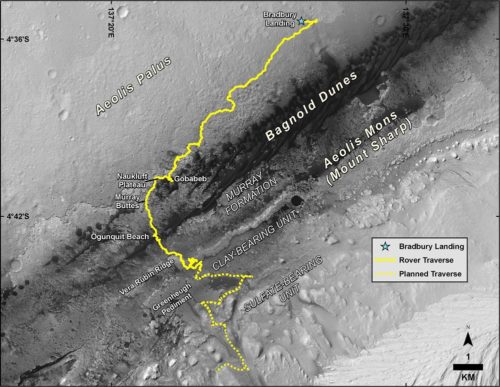
Check out this cool map showing Curiosity’s route since it landed on August 5, 2012:

Curiosity has now driven 13.10 miles (21.08 kilometers) since landing on Mars in August 2012.

A newly released Curiosity traverse map through Sol 2480 shows the route driven by the robot through the 2480 Martian day, or sol.

MSL Traverse Map as of Sol 2480
Map of Curiosity’s movements as of Sol 2480. Credit: NASA/JPL-Caltech/Univ. of Arizona. Click for larger image.

See also Curiosity Mission Updates – NASA Mars.

*** Strong evidence of water glaciers beneath the surface in many areas of Mars: The glaciers of Mars | Behind The Black

For the future colonists of Mars, the question of finding water will not be that much of a problem. Not only have planetary geologists mapped out the existence of extensive water-ice in the Martian poles, they have found that the planet apparently has widespread glacier deposits in two mid-latitude belts from 30 to 60 degrees latitude.

The question will be whether those Martian settlers will be able to easily access this water. The data so far suggests that much of the Martian underground water at high latitudes is likely mixed with dust and debris. Extracting it might not be straightforward. There are hints that the ice table at latitudes about 55 degrees might be more pure, but could be somewhat deep below ground, requiring the settlers to become miners to obtain their water. Moreover, all these high latitude locations are in environments that are more hostile, and therefore more difficult to establish a colony.

====

Fire in the Sky:
Cosmic Collisions, Killer Asteroids,
and the Race to Defend Earth

Space sciences roundup – July.17.2019

A sampling of recent articles, videos, and images from space-related science news items:

Asteroids

** JAXA Hayabusa2 made a successful 2nd sample grab from asteroid Ryugu on July 11th. The :

From SFN:

The robot explorer’s sampling mechanism works by firing a metal bullet into the asteroid once the probe’s sampler horn, which extends from one side of the spacecraft, contacts the surface. The projectile is designed to blast away rock and dust on the asteroid’s surface, then direct the material through the sampler horn into a collection chamber inside the Hayabusa 2 spacecraft.

This image shows debris thrown up from the surface of Ryugu by the bullet.

Hayabusa2 2nd Touchdown
Image of surface immediately after touchdown. Taken with the Optical Navigation Camera – Wide angle (ONC-W1). Credits: Hayabusa-2 project.

A diagram of the touch-and-go surface sampling operation:

Outline of the 2nd touchdown operation.

More about the The 2nd touchdown – JAXA Hayabusa2 project

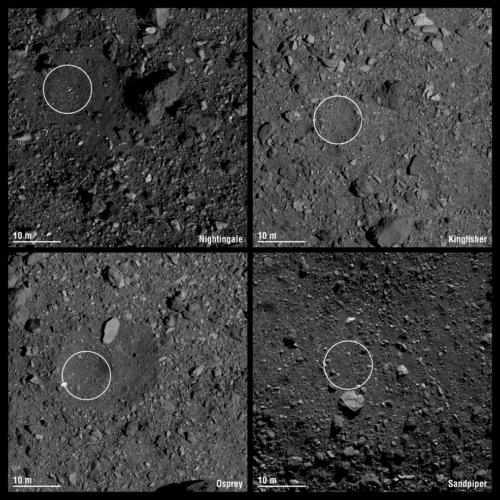
** Help OSIRIS-REx mission map the rugged surface of the Bennu asteroid  NASA Invites Public to Help Asteroid Mission Choose Sample Site | NASA

Citizen scientists assemble! NASA’s OSIRIS-REx mission to the asteroid Bennu needs extra pairs of eyes to help choose its sample collection site on the asteroid – and to look for anything else that might be scientifically interesting.

Bennu surface
“This image shows a view of asteroid Bennu’s surface in a region near the equator. It was taken by the PolyCam camera on NASA’s OSIRIS-REx spacecraft on March 21 from a distance of 2.2 miles (3.5 km). The field of view is 158.5 ft (48.3 m). For scale, the light-colored rock in the upper left corner of the image is 24 ft (7.4 m) wide. Credits: NASA/Goddard/University of Arizona”

The OSIRIS-REx spacecraft has been at Bennu since Dec. 3, 2018, mapping the asteroid in detail, while the mission team searches for a sample collection site that is safe, conducive to sample collection and worthy of closer study. One of the biggest challenges of this effort, which the team discovered after arriving at the asteroid five months ago, is that Bennu has an extremely rocky surface and each boulder presents a danger to the spacecraft’s safety. To expedite the sample selection process, the team is asking citizen scientist volunteers to develop a hazard map by counting boulders.

“For the safety of the spacecraft, the mission team needs a comprehensive catalog of all the boulders near the potential sample collection sites, and I invite members of the public to assist the OSIRIS-REx mission team in accomplishing this essential task,” said Dante Lauretta, OSIRIS-REx principal investigator at the University of Arizona, Tucson.

For this effort, NASA is partnering with CosmoQuest, a project run out of the Planetary Science Institute that supports citizen science initiatives. Volunteers will perform the same tasks that planetary scientists do – measuring Bennu’s boulders and mapping its rocks and craters – through the use of a simple web interface. They will also mark other scientifically interesting features on the asteroid for further investigation.

The boulder mapping work involves a high degree of precision, but it is not difficult. The CosmoQuest mapping app requires a computer with a larger screen and a mouse or trackpad capable of making precise marks. To help volunteers get started, the CosmoQuest team provides an interactive tutorial, as well as additional user assistance through a Discord community and livestreaming sessions on Twitch.

For more info see:

Microgravity Science & Technology R&D

** SpaceX Cargo Dragon to deliver wide range of science and technology experiments to the ISS. Liftoff of mission CRS-18 is currently set for July 21st at 7:35 pm EDT (2335 GMT)

Highlights of Science Launching on SpaceX CRS 18 – July 8, 2019 –

Solar Science

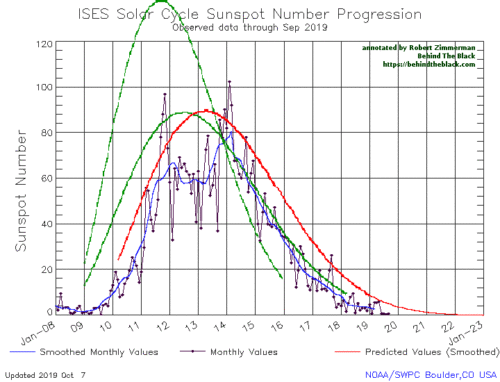
** Sunspot count near zero in June. Faint spots subsequently show signs of start of next cycle: Sunspot update June 2019: Down to zero again, with next cycle making an appearance | Behind The Black

These two visible sunspots for the next solar cycle are very significant. They indicate that we will have an upcoming solar maximum, and are not heading into a grand minimum, when no sunspots are visible for decades.

Their appearance however does not mean that solar minimum is over. On the contrary, the solar cycles typically overlap by one or two years, with new sunspots for the next solar cycle appearing even as the Sun ramps down to minimum and remains relatively inactive for many months.

I cannot deny that I will be disappointed if a grand minimum does not occur. Such an event would have been a wonderful opportunity for solar scientists to get answers to their many questions about the Sun’s solar cycles that today remain unanswered and will likely not be answerable while the Sun follows its behavior of the last three hundred years.

At the same time, if the upcoming solar cycle is weak, as has been predicted by some solar scientists, it will help confirm some theories that try to explain the Sun’s behavior.

ISES Solar Cycle Sunspot Number Progression - NOAA

Check SpaceWeather.com for the daily sunspot count. More solar images and measurements can be found on the Space-for-All page The Sun & Space Weather.

Continue reading Space sciences roundup – July.17.2019

Night sky highlights for July 2019

** NASA JPL posts What’s Up Video: July 2019 | NASA

As NASA marks the 50th anniversary of the Apollo 11 Moon landing, here are five things to know about the Moon that you can share with others: How far away is the Moon? How big is the Moon? What color is the Moon? Why do we always see the same side of the Moon? And what are the dark areas on the Moon?

** The Hubble Space Telescope Science Institute posts “Tonight’s Sky: July 2019”:

In July, find the Scorpius constellation to identify the reddish supergiant Antares, which will lead you to discover a trio of globular star clusters. Keep watching for space-based views of these densely packed, spherical collections of ancient stars, as well as three nebulas: the Swan Nebula, the Lagoon Nebula, and the Trifid Nebula.

** Alyn Wallace posts his program on the July 2019 night sky:

** A preview of the month’s night sky plus a schedule for some space related events: Skywatch: What’s happening in the heavens in July – The Washington Post

====

LEGO Ideas NASA Apollo Saturn V 21309
Outer Space Model Rocket for Kids and Adults, Science Building Kit
(1900 pieces)

Space sciences roundup – June.13.2019

A sampling of recent articles, videos, and images from space-related science news items:

** ESA-led Heracles mission will return samples of the lunar surface to Earth: Landing on the Moon and returning home: Heracles – ESA

The Heracles lander will target a previously unexplored region near the lunar South Pole as an interesting area for researchers. A lander with a rover inside and ascent module on top will land there. Monitored and controlled from the lunar Gateway, the rover will scout the terrain in preparation for the future arrival of astronauts, and collect samples. The ascent module will take off from the surface and fly to the Gateway with the samples taken by the rover.

When the ascent module carrying the sample container arrives, the Gateway’s robotic arm will capture it and extract the sample container. The sample container will be received by the astronauts via a science airlock and pack it in NASA’s Orion spacecraft that is powered by the European Service Module. Orion will fly to Earth with astronauts and land with the Heracles lunar samples for analysis in the best laboratories on Earth.

** Massive metal deposit may underlie the Moon’s South Pole–Aitken basin: Mass Anomaly Detected Under the Moon’s Largest Crater – Baylor University

A mysterious large mass of material has been discovered beneath the largest crater in our solar system — the Moon’s South Pole-Aitken basin — and may contain metal from an asteroid that crashed into the Moon and formed the crater, according to a Baylor University study.

“Imagine taking a pile of metal five times larger than the Big Island of Hawaii and burying it underground. That’s roughly how much unexpected mass we detected,” said lead author Peter B. James, Ph.D., assistant professor of planetary geophysics in Baylor’s College of Arts & Sciences.

The crater itself is oval-shaped, as wide as 2,000 kilometers — roughly the distance between Waco, Texas, and Washington, D.C. — and several miles deep. Despite its size, it cannot be seen from Earth because it is on the far side of the Moon.

Dennis Wingo has long claimed that asteroid impacts on the Moon have enriched it with vast quantities of valuable metals.

Many other space scientists have claimed that the materials of such bodies were vaporized on impact and thinly spread over the Moon and thus not accessible by standard mining techniques.

** The Psyche mission will study a metallic asteroid up close :  NASA’s Psyche Mission Has a Metal World in Its Sights – NASA

Designed to explore a metal asteroid that could be the heart of a planet, the Psyche mission is readying for a 2022 launch. After extensive review, NASA Headquarters in Washington has approved the mission to begin the final design and fabrication phase, otherwise known as Phase C. This is when the Psyche team finalizes the system design, develops detailed plans and procedures for the spacecraft and science mission, and completes both assembly and testing of the spacecraft and its subsystems.

“The Psyche team is not only elated that we have the go-ahead for Phase C, more importantly we are ready,” said Principal Investigator Lindy Elkins-Tanton of Arizona State University in Tempe. “With the transition into this new mission phase, we are one big step closer to uncovering the secrets of Psyche, a giant mysterious metallic asteroid, and that means the world to us.”

The mission still has three more phases to clear. Phase D, which will begin sometime in early 2021, includes final spacecraft assembly and testing, along with the August 2022 launch. Phase E, which begins soon after Psyche hits the vacuum of space, covers the mission’s deep-space operations and science collection. Finally, Phase F occurs after the mission has completed its science operations; it includes both decommissioning the spacecraft and archiving engineering and science data.

The Psyche spacecraft will arrive at Asteroid Psyche on Jan. 31, 2026, after flying by Mars in 2023.

The mission will also test laser communications with deep space probes:

Deep Space Optical Communications (DSOC)
Diagram of tests of the Deep Space Optical Communications (DSOC) package on the Psyche spacecraft.

** A review of the Hayabusa2 mission to the Ryugu asteroid, since its arrival in June of 2018: Treasure Hunting With Hayabusa2 – The Planetary Society

So far, multiple devices have been placed on the surface and an explosive was set off as well. A prime goal of the mission is to return a surface sample to Earth. One sampling was made in February.

Hayabusa2 Touchdown
Sampling Ryugu: “The moment that Hayabusa2 contacted asteroid Ryugu, it fired a bullet through its sampler horn (center) to knock material loose from the surface and then immediately fired its thrusters to ascend. This photo sequence, taken from an altitude of up to about 15 meters, demonstrated the success of the bullet; dark-colored fragments tumble in Hayabusa2’s shadow in the space beneath the craft.” Credits: JAXA and the Planetary Society

As this article goes to press, we are deciding whether to collect a second sample from a region close to the crater or from a second site on the asteroid. This second sample will likely be our last since by July, Ryugu will be nearing the perihelion of its orbit, and its surface will become too warm for touchdown operations.

Hayabusa2 will then continue to examine Ryugu remotely until the end of the year and return to Earth with the samples at the end of 2020. It is going to be a busy few years!

This week the spacecraft made a “Low descent observation operation“, that is, it came in close and successfully dropped a target marker on the surface of the asteroid.

Preparations for the descent began on June 11 and the descent will begin on June 12 at 11:40 JST (on-board time) with the spacecraft descending at a speed of 0.4m/s. The speed will be reduced to 0.1 m/s at 22:00 JST on the same day. The spacecraft will read an altitude of about 35m on June 13 at 10:34 JST and then begin to ascend from 10:57 JST. The schedule of the operation is shown in Figure 1. Please be aware that the actual operation time may differ as the times shown are the planned values.

Low altitude sequence
Low altitude sequence for PPTD-TM1B. Credit: JAXA.

A view of Ryugu as the spacecraft closed in on it:

Ryugu - June.13.2019
A view of Ryugu on June 13th from Hayabusa2 as it approached the surface.

To make a model of Hayabusa2, check out the JAXA paper models page.

** An update on operational science spacecraft spread throughout the solar system: Where We Are: An At-A-Glance Spacecraft Locator | The Planetary Society

Where We Are 2019-July-1
A diagram illustrating status of space science missions. Credits: Loren Roberts for The Planetary Society after a concept by Olaf Frohn

** Privately funded instrument on ESO’s VLT to search for near-by earth-like exoplanets: Breakthrough Watch and the European Southern Observatory achieve “first light” on upgraded planet-finding instrument to search for Earth-like planets in nearest star system | ESO

Newly-built planet-finding instrument installed on Very Large Telescope, Chile, begins 100-hour observation of nearby stars Alpha Centauri A and B, aiming to be first to directly image a habitable exoplanet

Breakthrough Watch, the global astronomical program looking for Earth-like planets around nearby stars, and the European Southern Observatory (ESO), Europe’s foremost intergovernmental astronomical organisation, today announced “first light” on a newly-built planet-finding instrument at ESO’s Very Large Telescope in the Atacama Desert, Chile.

The instrument, called NEAR (Near Earths in the AlphaCen Region), is designed to hunt for exoplanets in our neighbouring star system, Alpha Centauri, within the “habitable zones” of its two Sun-like stars, where water could potentially exist in liquid form. It has been developed over the last three years and was built in collaboration with the University of Uppsala in Sweden, the University of Liège in Belgium, the California Institute of Technology in the US, and Kampf Telescope Optics in Munich, Germany.

ESO’s Very Large Telescope (VLT) has recently received an upgraded addition to its suite of advanced instruments. On 21 May 2019 the newly modified instrument VISIR (VLT Imager and Spectrometer for mid-Infrared) made its first observations since being modified to aid in the search for potentially habitable planets in the Alpha Centauri system, the closest star system to Earth. This stunning image of the VLT is painted with the colours of sunset and reflected in water on the platform. While inclement weather at Cerro Paranal is unfortunate for the astronomers using it, it lets us see ESO’s flagship telescope in a new light.

More about the Watch project can be found at Breakthrough Initiatives, which is funded by Yuri Milner.

** Starshades would enable space telescopes to image earth-like exoplanets by masking out the light of their stars. NASA’s Starshade Technology Development program (ExEP) has come up with techniques for maintaining the extremely precise alignment needed between the starshade and the telescope, which will reside tens of thousands of kilometers apart: Starshade Would Take Formation Flying to Extremes | NASA.

“We can sense a change in the position of the starshade down to an inch, even over these huge distances,” Bottom said.

But detecting when the starshade is out of alignment is an entirely different proposition from actually keeping it aligned. To that end, Flinois and his colleagues developed a set of algorithms that use information provided by Bottom’s program to determine when the starshade thrusters should fire to nudge it back into position. The algorithms were created to autonomously keep the starshade aligned with the telescope for days at a time.

Combined with Bottom’s work, this shows that keeping the two spacecraft aligned is feasible using automated sensors and thruster controls. In fact, the work by Bottom and Flinois demonstrates that engineers could reasonably meet the alignment demands of an even larger starshade (in conjunction with a larger telescope), positioned up to 46,000 miles (74,000 kilometers) from the telescope.

A starshade project has not yet been approved for flight, but one could potentially join WFIRST in space in the late 2020s. Meeting the formation-flying requirement is just one step toward demonstrating that the project is feasible.

A demo of a starshade deployment:

**  Hubble images a small galaxy “furiously forming” stars : Hubble Observes Tiny Galaxy with Big Heart | ESA/Hubble

Nestled within this field of bright foreground stars lies ESO 495-21, a tiny galaxy with a big heart. ESO 495-21 may be just 3000 light-years across, but that is not stopping the galaxy from furiously forming huge numbers of stars. It may also host a supermassive black hole; this is unusual for a galaxy of its size, and may provide intriguing hints as to how galaxies form and evolve.

Nestled within this field of bright foreground stars lies ESO 495-21, a tiny galaxy with a big heart. ESO 495-21 is just 3000 light-years across, a fraction of the size of the Milky Way, but that is not stopping the galaxy from furiously forming huge numbers of stars. There are also indicators for a supermassive black hole in its centre – an unusual component for a galaxy of its size.

** Mars:

** Mars 2020 rover includes instruments for detecting signs of life: Johnson-Built Device to Help Mars 2020 Rover Search for Signs of Life | NASA

Next summer, NASA is launching the Mars 2020 robotic rover to the Red Planet, loaded with equipment to search for signs that there once was life on Mars. One device, called the Scanning Habitable Environments with Raman & Luminescence for Organics & Chemicals (SHERLOC) instrument, will be used to detect chemicals on the Martian surface that are linked to the existence of life. To keep the instrument working well, a team from the Astromaterials Research and Exploration Science (ARES) division at NASA’s Johnson Space Center (JSC) recently built a new calibration device for the rover to check SHERLOC’s function and properly tune it during the upcoming mission.

“SHERLOC is pretty complicated, and we came up with a list of 11 things that all have to be calibrated on this instrument,” said Marc Fries, ARES planetary scientist and Mars 2020 instrument co-investigator. “This sophisticated calibration device is also going to be used for a lot of other scientific and engineering investigations, and we’re really excited that it’s JSC’s contribution to the Mars 2020 rover.”

** And Mars 2020 rover instruments will help with human missions as well: NASA’s Mars 2020 Will Blaze a Trail – for Humans – NASA JPL

When a female astronaut first sets foot on the Moon in 2024, the historic moment will represent a step toward another NASA first: eventually putting humans on Mars. NASA’s latest robotic mission to the Red Planet, Mars 2020, aims to help future astronauts brave that inhospitable landscape.

While the science goal of the Mars 2020 rover is to look for signs of ancient life – it will be the first spacecraft to collect samples of the Martian surface, caching them in tubes that could be returned to Earth on a future mission – the vehicle also includes technology that paves the way for human exploration of Mars.

** More Mars exploration with Bob Zimmerman:

*** Ghost dunes on Mars – A “Star Trek Federation” logo feature is created by winds blowing on sand dunes:

Cool image time! The Mars Reconnaissance (MRO) science team today released a captioned image of several ghost dunes on Mars. The image [below] is cropped and reduced to highlight one of those ghosts, which the scientists explain as follows.

Long ago, there were large crescent-shaped (barchan) dunes that moved across this area, and at some point, there was an eruption. The lava flowed out over the plain and around the dunes, but not over them. The lava solidified, but these dunes still stuck up like islands. However, they were still just dunes, and the wind continued to blow. Eventually, the sand piles that were the dunes migrated away, leaving these “footprints” in the lava plain.

Dune Footprints in Hellas
“These curious chevron shapes in southeast Hellas Planitia are the result of a complex story of dunes, lava, and wind.” – HiRISE at Univ. of Arizona

*** The Martian North Pole –  A tour of the many weird features of the Martian north pole area:

Since the very beginning of telescopic astronomy, the Martian poles have fascinated. Their changing sizes as the seasons progressed suggested to the early astronomers that Mars might be similar to Earth. Since the advent of the space age we have learned that no, Mars is not similar to Earth, and that its poles only resemble Earth’s in a very superficial way.

Yet, understanding the geology and seasonal evolution of the Martian poles is critical to understanding the planet itself.

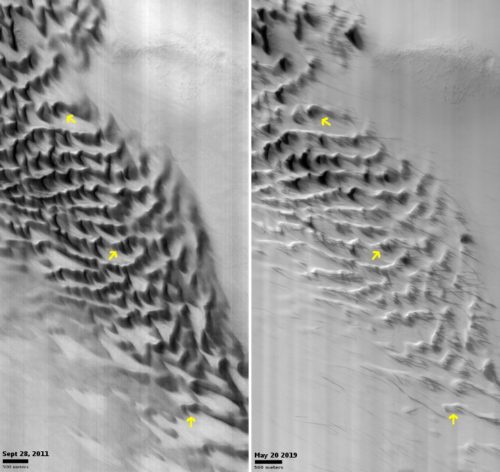
Dunes Dubbed Cool Fans
Dunes Dubbed Cool Fans – HiRISE at Univ. of Arizona

====

Brief Answers to the Big Questions – Stephen Hawking