Category Archives: Space transport roundup

Latest on all means of traveling to, from and in space.

Space transport roundup – Part 1: SpaceX – May.18.2021

Here is a sampling of recent articles, videos, and images dealing with space transport (find previous roundups here). Here Part 1 focuses on  SpaceX. Part 2 reports on news from other space transportation companies and organizations around the world.

** Multiple developments across the board at SpaceX since the last roundup on April 8th. Here is a list of some of the highlights:

  • Five Falcon 9 launches:
    1. April 23:  SpaceX Crew-2 mission sent Dragon Endeavor with four astronauts to the ISS. Both the Dragon and the F9 booster had flown previously.
    2. April 28: Starlink V1.0 L24 – 60 satellites to orbit and booster recovered after its 7th flight.
    3. May 4:  Starlink V1.0 L25 – 60 satellites to orbit. Booster lands safely after 9th flight. This was the 100th successful mission since the last in-flight F9 failure.
    4. May 9: Starlink V1.0 L27 – 60 satellites to orbit.  First stage booster flies for 10th time and lands safely.
    5. May.15: Starlink V1.0 L26 – 52 Starlink satellites to orbit plus rideshare for Capella radarsat and Tyvek smallsat with miniature telescope. Booster lands for 8th time.
  • Dragon reentry:
    • May 2: SpaceX Crew-1 mission astronauts return from ISS aboard Dragon Resilience for a rare night time splashdown at a spot near Florida’s Gulf coast.
  • Starship milestones:
    • April 16: NASA selects SpaceX Starship proposal as single winner for Artemis Human Landing System (HLS) funding. The $2.9B program would support development of the Lunar version of the Starship and fund two missions (uncrewed and crewed) to the Moon’s surface.
    • May 5: First successful landing of a Starship prototype after a flight to a high altitude.
    • May 14: Plan released showing primary features of the first “orbital” Starship mission, which could happen as early as this summer.
  • Other developments:

** May 14: Outline of Starship “orbital” mission released in FCC filing. Perhaps within a few months, the first launch of a Starship atop a Super Heavy Booster will lift off from Boca Chica Beach, ala Starbase, Texas. The primary goals of the mission are provided in a filing with the FCC, Starship Orbital – First Flight FCC Exhibit – FCC (pdf).

Flight Profile
The Starship Orbital test flight will originate from Starbase, TX. The Booster stage will separate approximately 170 seconds into flight. The Booster will then perform a partial return and land in the Gulf of Mexico approximately 20 miles from the shore. The Orbital Starship will continue on flying between the Florida Straits. It will achieve orbit until performing a powered, targeted landing approximately 100km (~62 miles) off the northwest coast of Kauai in a soft ocean landing.
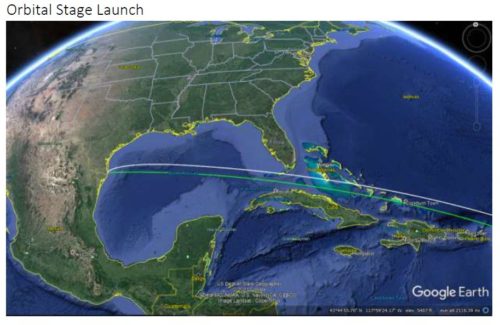
The launch will thread the Starship between Cuba and other Caribbean islands while the Super Heavy will return for a water landing off the coast of Texas. Credits: SpaceX

So the Starship (SN20?) will reach orbital velocity but will fire its engines for reentry before completing a complete orbit.

Objectives
SpaceX intends to collect as much data as possible during flight to quantify entry dynamics and better understand what the vehicle experiences in a flight regime that is extremely difficult  to accurately predict or replicate computationally. This data will anchor any changes in vehicle design or CONOPs after the first flight and build better models for us to use in our internal simulations.
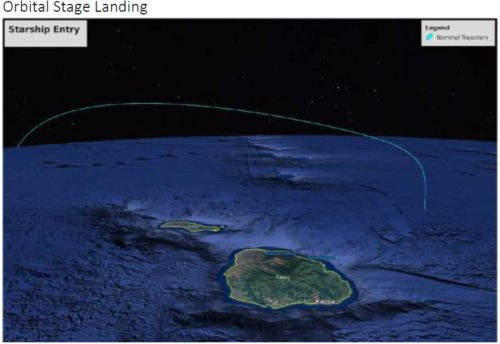
The Starship will fire make its de-orbit burn before completing a full circle of the Earth. The reentry trajectory will put the ship into the ocean near Hawaii. Credits: SpaceX

Unfortunately, the 28 Raptors on the booster and the 6 on the Starship (including 3 with large vacuum optimized nozzles) will likely be lost on this mission.  Even if production is nearing Elon’s goal of $1M per engine, it will be a significant loss down the ocean drain. For perspective, though, consider that each of the four Shuttle engines (de-rated from reusable to expendable) on a throwaway Space Launch System, will cost $146M, several times more than the combined cost of all those Raptors.

See also:

** May.5: SN15 becomes first SpaceX Starship prototype to fly to high altitude and survive landing. A small fire flared at the base for a few minutes after touchdown but did not lead to the destruction of the vehicle as happened with SN10.  Much of the flight was hidden from view by thick clouds but the takeoff and landing were visible to the thousands watching in person and via the various webcasts. SpaceX provided live video views from a camera in the rocket engine compartment and from one of a flap near the front.  While there were long breaks in the video transmission, telemetry indicated the flight was going well. Elon Musk tweeted after the fire was out, “Starship landing nominal!

Here is a highlights video released by SpaceX on May 13th:

On Wednesday, May 5, Starship serial number 15 (SN15) successfully completed SpaceX’s fifth high-altitude flight test of a Starship prototype from Starbase in Texas. SN15 ascended, transitioned propellant, and reoriented itself for reentry and a controlled aerodynamic descent. The Raptor engines reignited to perform the landing flip maneuver before touching down for a nominal landing on the pad. These Starship test flights improve our understanding and development of a fully reusable transportation system designed to carry crew and cargo on long-duration interplanetary flights, help humanity return to the Moon, and travel to Mars and beyond.

High-res views from Cosmic Perspective:

Starship development is moving forward roughly in blocks of 5. The early prototypes SN1-SN4 had only the propellant tank sections and were used primarily for structural pressure tests. This involved implementing the various ground support systems and interfaces to the vehicle and gaining experience with preparing a vehicle for flight. SN5 and SN6 also had no nosecones but carried out short hop flights. The SN7 tag  was assigned to modules for testing the propellant tanks. The SN8 vehicle included the nosecone section and was the first vehicle to go to high altitude (~12km).  It and vehicles SN9-SN11 all flew to the 12 km range but either failed during landing attempts or, in SN10’s case, blew up a few minutes after landing. Some components and assembly steps  were observed for SN12 and SN13 but these were eventually junked in favor of jumping to the SN15 block.

SN15 reportedly involved many improvements over the previous vehicles, making it a significant step up from the SN8-13 design. Most of these improvements are internal and have not been detailed publicly. (Here is a guess at changes in the piping to the engines.)  However, to the outside observer the three Raptor engines installed on SN15 display a much neater and uniform arrangement of piping and cabling, indicating that the engines are transitioning from developmental prototypes to operational units.

Shortly after the landing, Elon said that the SN15 might fly again soon. It was later moved to the second suborbital launch platform. The SN16 prototype appears to be complete but no word on when and if it will be moved from the High Bay hangar to the launch site.

Some articles about the SN15:

**** More Starship related items below.

Falcon 9/Dragon

** May.15: Falcon 9 launches from Kennedy Space Center with 52 Starlinks plus two rideshare satellites. The booster landed successfully on platform at sea for the 8th time. The  rideshare satellites included a Tyvak smallsat with a miniature space telescope and Capella Space small synthetic aperture radar imaging satellite.

** May.9.2021: Falcon 9 launches 60 Starlink satellites and booster successfully flies for 10th time on Starlink V1.0 L27. The original goal of 10 booster flights and landings before a major refurbishment was reached with this mission. It appears, in fact, that refurbishment between flights is sufficient to keep a booster flying so this one will probably do another flight within the usual 1 to 2 month gap between booster flights.

** May.4: SpaceX launches 60 more Starlink satellites on Starlink V1.0 L25 mission. Booster lands after its 9th flight.

** May.2: SpaceX Dragon “Resilience” splashes down in darkness with Crew-1 astronauts from the ISS. The SpaceX Crew-1 mission members – NASA astronauts Michael Hopkins, Victor Glover, Shannon Walker and JAXA astronaut Soichi Noguch – completed their 6 month stay aboard the station and, after a few days delay due to bad weather in the recovery area in the Gulf of Mexico near the Florida panhandle, departed from the station on the evening of May 1st. This was only the third nighttime water landing in spaceflight history.
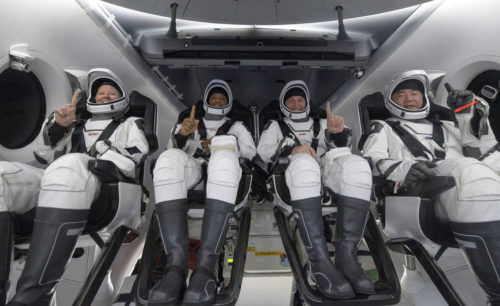
NASA astronauts Shannon Walker, left, Victor Glover, Mike Hopkins, and Japan Aerospace Exploration Agency (JAXA) astronaut Soichi Noguchi, right are seen inside the SpaceX Crew Dragon Resilience spacecraft onboard the SpaceX GO Navigator recovery ship shortly after having landed in the Gulf of Mexico off the coast of Panama City, Florida, Sunday, May 2, 2021. NASA’s SpaceX Crew-1 mission was the first crew rotation flight of the SpaceX Crew Dragon spacecraft and Falcon 9 rocket with astronauts to the International Space Station as part of the agency’s Commercial Crew Program. Photo Credit: (NASA/Bill Ingalls)

*** Apr. 28: SpaceX Falcon 9 launches 60 more Starlink satellites. The first stage booster landed safely on its seventh flight.

*** Apr.23: SpaceX Crew Dragon launched with 4 new crew members for the ISS. The Falcon 9, with a previously flown first stage, lifted off early in the morning of April 23rd with a previously flown Dragon. The Crew-2 flight is the second operational Crew Dragon flight and the third Dragon flight with astronauts on board counting the Demo 2 mission that launched on May 30, 2020. The Crew-2 astronauts rode the same Crew Dragon Endeavour that flew on the Demo-2 mission. The F9 booster propelled the Crew-1 mission last November. The booster landed safely again on a floating platform in the Atlantic.

The Dragon rendezvoused and docked to the station early on April 24th:

An overview of the mission:

NASA’s SpaceX Crew-2 mission to the International Space Station is ready to launch. Join NASA’s Shane Kimbrough and Megan McArthur, Aki Hoshide of the Japan Aerospace Exploration Agency (JAXA), and Thomas Pesquet of ESA (European Space Agency) as they talk about the prospect of flying on a new spaceship, the six-month space mission they’ve been preparing for, and the future in space they’re helping to build.

*** SpaceX ends effort to catch Falcon 9 fairings in nets atop ships at sea. As explained by Scott Manley in this video, the percentage of successful catches was quite low while recovering the fairings from the water and refurbishing them for flight has become quite doable.

SpaceX has dismantled the massive nets on Ms Tree and Ms Chief which were used for catching fairings falling from space, but, they still have a large fleet of ships used for ocean recovery operations so this seems like a perfect opportunity to talk about this: More info on SpaceX’s Ships https://spacexfleet.com/

See also SpaceX has Given up Trying to Catch Rocket Fairings. Fishing Them out of the Ocean is Fine – Universe Today.

** A new Falcon 9 first stage arrives at Cape Canaveral. With the number of flights per booster steadily increasing, the demand for first stages has dropped significantly. The arrival of a new one has become an unusual event. SpaceX delivers new Falcon 9 booster for the first time in 8 months – Teslarati

** Eric Berger, Early Days of SpaceX – Here is a video of a presentation given at the symposium titled, NASA and the Rise of Commercial Space: A Symposium to Examine the Meaning(s) and Context(s) of Commercial Space. Berger is the author of Liftoff: Elon Musk and the Desperate Early Days That Launched SpaceX [Amazon commission link]. The

From activities in low-Earth orbit to the Artemis program, the commercial space industry is beginning to take on an increased role as innovator in both space access, commerce, and exploration. This growth of commercial space over the past decades offers the potential for a new paradigm for space exploration—one in which industry transitioned from supplier to partner. Still, many questions remain spanning from the most seemingly consequential “How will humanity explore the Moon and Mars?” to the more basic, “What is Commercial Space?” This virtually hosted symposium explores this transformation and examines the historical context for answering these questions.

** The Space Show – Tuesday, Apr.27.2021Eric Berger of Ars Technica discussed

his new book about the beginning phase of SpaceX, Liftoff: Elon Musk and the Desperate Early Days That Launched SpaceX [Amazon commission link]. Eric responded to multiple questions about Artemis, the recent NASA Human Lander Award and what might come next plus general Elon Musk and SpaceX questions.

** T+187: Eric Berger on Artemis, Starship, Amazon’s Atlas V Rides, and the State of Blue Origin – Main Engine Cut Off

Eric Berger of Ars Technica returns to the show to talk about NASA selecting SpaceX’s Starship for its Artemis landings, Bill Nelson’s nomination hearing, Amazon buying 9 Atlas V launches for Kuiper, and the state of Blue Origin.

==================

Check out the
The Lurio Report
for news and analysis of key developments in NewSpace

The latest issue:
Starships and Luna, Commercial LEO, Sen. Nelson
Vol. 16, No. 3, April 3, 2021

Space Frontier Foundation Award for NewSpace Journalism

==================

Starship/Super Heavy Booster

** Latest diagram showing status of Starship and Super Heavy Booster prototypes in construction and operation:

[ Update: The status and fates of all the prototypes so far:

]

*** SpaceX wins NASA contract for human missions to the Moon. NASA surprised the space world with the announcement that SpaceX was the sole winner of the initial Human Lander System contract. The company will get $2.9B for two StarShip missions to the Moon. The first will demonstrate a landing of an uncrewed Starship on the lunar surface and then lift off and return to orbit. The second mission will send a US crew to the surface for the first time since the Apollo 17 lunar excursion module left in 1972. Elon Musk believes these missions can be accomplished by 2024, the original date of the Artemis program, which many had come to believe was impossible with current funding for the program.

The contract was subsequently suspended until resolution of the award protests by HLS program competitors Blue Origin and Dynetics. The successful flight and landing of Starship prototype SN15 (see top item) boosts the claims by NASA and SpaceX that the development of the Starship systems are well ahead of the other bidders and on track for reaching the Moon by the mid-2020s if not by 2024.

Here is the Human Landing System Announcement Media Teleconference where the announcement of the selection was made. (The event starts at the 9:30 point into the video):

The Magic of SpaceX w/ Eric Berger  – David Lee on Investing (Ep. 310)  – An informative interview with Eric Berger about  Elon Musk and SpaceX on the day the company won the HLS contract:

*** Independent analyses of Starship/Super Heavy performance:

Casey Handmer discussed his studies of the Starship/Super Heavy capabilities in a recent interview on The Space Show: Broadcast 3686 Dr. Casey Handmer | The Space Show

Starship enables lunar activities and settlement on a sci-fi scale. Handmer shows that Starships could deliver hundreds of tons of cargo to the Moon per year at a cost well within NASA’s current budget: Lunar Starship and unnecessary operational complexity – Casey Handmer’s blog

It’s worth stating at the outset that Starship is in a league of its own in the current field of lunar landers. Within the HLS program, the NASA spec called for a capacity of at least 9 T, ideally 12 T, to the Lunar surface. Starship in its most basic configuration can do more than 200 T. One of these is not like the others.

The real strength of Starship is not in its transformationally large cargo capacity, but in its low cost of operations. Why fly 200 T once when we could fly it a few dozen times for less than the cost of the next cheapest vehicle?

A single Starship flight to the Moon can transport 25 [Tons] of mission-related cargo there and back, which is more than enough to support a crew of 10 for weeks, and give them a Moon rover each. Add to this the beginnings of an enormous lunar space station built inside an expendable Starship-based lander and not only is the Artemis program affordable, it’s also achieving something like an exciting science-fiction based vision for what a Moon base should look and feel like.

No NRHO [Near-rectilinear halo orbit] phasing requirements, no launch windows, no decades-long roll out of incredibly expensive deep space infrastructure. Just a vehicle built around the given task and committed to achieving it without compromises. A mission architecture capable of deploying a large lunar base for a cost comparable to the NSF’s new(ish) South Pole Station. With a budget of $1b/year, NASA could fly this mission (or variations on the theme) every 90 days – a big step change improvement over space access with the ISS.

** More about the impact Starships will have on space exploration and development:

** A vivid perspective illustrating the relative distance between the production area and the launch/landing facilities at Boca Chica Beach:

** NASA funding for SpaceX in-space cryogenic propellant transfer demo: Last year NASA announced plans to award $370M in funding for demonstrations of various “Tipping Point” technologies. The term tipping point here implies that a technology has reached an advanced level of development but needs one final demo boost to prove that it is ready for operational use.

SpaceX was one of several companies awarded funding for projects involving propellant transfer and storage in space. The $50M for SpaceX has now arrived, which will enable the company to carry out a demonstration in orbit of cryogenic propellant transfer by the end of 2022:

Transferring liquid methane and oxygen in orbit is a key factor in the Starship architecture. A Starship can reach low earth orbit from Earth but to go on to the Moon, Mars, and other deep space destinations, it will need to fill up on propellants delivered from earth.

** Some videos from Boca Chica Beach/Starbase, Texas:

*** May 7: SpaceX Starship SN15 & Starbase Tx FlyoverRGV Aerial Photography

*** May.15: New Starbase Sign Unveiled | SpaceX Boca ChicaNASASpaceflight – YouTube

SpaceX unveils a new Starbase sign outside of the Propellant Production Site. SpaceX aims to incorporate the area as Starbase, TX as they push toward the first orbital launch. Video & Photos from Mary (@BocaChicaGal) and the NSF Robotic Camera Team. Edited by Brady Kenniston (@TheFavoritist)

*** May.16: Two Massive Cranes Assembled | SpaceX Boca ChicaNASASpaceflight – YouTube

As Starship SN15 is inspected for a potential second flight, SpaceX crews assemble two new massive cranes to assist in Orbital Launch Site construction. Video & Photos from Mary (@BocaChicaGal). Edited by Brady Kenniston (@TheFavoritist)

*** May.17New Crane for Orbital Site Construction Comes Together | SpaceX Boca ChicaNASASpaceflight – YouTube

The new Liebherr LR 11000 crane has the rest of its large components assembled, minus its full boom. Once complete it will assist Frankencrane in Orbital Launch Site construction. Video & Photos from Mary (@BocaChicaGal). Edited by Brady Kenniston (@TheFavoritist)

** More SpaceX related reports:

*** May.18: SpaceX Starship SN20 Orbital Flight Analyzed – Flight Plan released!What about it!?

*** May.15: SpaceX Starship development shifts focus to orbital flight with Super Heavy Marcus House

*** Apr.17: NASA Will Spend $2,941,394,557 On SpaceX’s Massive Lunar Starship Lander!!!Scott Manley

Many people were surprised yesterday when news leaked that NASA was awarding all the funding from the Artemis Human Landing System program to SpaceX with its massive Lunar Starship project. SpaceX’s price tag is about $2.9 billion with a commitment to fund half of it themselves. While most space watchers could see why SpaceX had made it to the final round most of us didn’t expect it to be the only choice because it was so unlike what NASA was asking for. However the HLS program only got 1/3 of the money it needed from Congress and with time marching on NASA had to make a decision and the only option with a price tag that fit was SpaceX.

** More SpaceX news & resources:

Now proceed to Space transport roundup – Part 2: Everybody Else – May.18.2021

=== Amazon Ads ===

Test Gods:
Virgin Galactic and the Making of a Modern Astronaut

=== Amazon Ad ===

Liftoff: Elon Musk and the Desperate Early Days
That Launched SpaceX
Space transport roundup – April.8.2021

A sampling of recent articles, videos, and images dealing with space transport (find previous roundups here):

** Apr.8: The Starship prototype SN15 moved to launch site. The vehicle has many upgrades according to Elon Musk. A test flight could happen within a week or two. I certainly hope it achieves the first successful landing of a Starship (without a post touchdown explosion) after rising to high-altitude (~10km).

** Apr.7: Falcon 9 puts another batch of 60 Starlinks into orbit. This is the tenth SpaceX Falcon 9 mission in 2021. The total number of Starlink satellites in orbit is increased to 1,378. The first stage booster made its 7th successful landing. And it makes for the 79th booster landing to date. Both fairing halves were also previously flown.

More at:

** Mar.30: Starship SN11 lifted off in dense fog, flew to 10 km, descended back into fog bank, and then exploded just before landing. The fog prevented the usual eruption of replays of a Starship explosion across the Web but also kept anyone from seeing exactly what happened. The SpaceX website offered this info:

On Tuesday, March 30, SpaceX launched its fourth high-altitude flight test of Starship from Starbase in Texas. Similar to previous high-altitude flight tests, Starship Serial Number 11 (SN11) was powered through ascent by three Raptor engines, each shutting down in sequence prior to the vehicle reaching apogee – approximately 10 km in altitude. SN11 performed a propellant transition to the internal header tanks, which hold landing propellant, before reorienting itself for reentry and a controlled aerodynamic descent.

Shortly after the landing burn started, SN11 experienced a rapid unscheduled disassembly. Teams will continue to review data and work toward our next flight test.

On Twitter, Elon initially provided some hints of what happened:

On April 5th, he revealed the results of subsequent analysis:

For the Falcon 9, SpaceX has always emphasized that the nine engines on the first stage are shielded from one another such that even a catastrophic failure of one will not affect the others and prevent destruction of the rocket. There have in fact been a couple of in-flight engine failures and the boosters continue to fly nonetheless. (The most recent case occurred in February and did prevent the booster from successfully landing.)  The Raptors do not appear to be shielded in the prototypes flow so far and perhaps this “hard start”, i.e. engine explosion, was so violent that no practical shielding could have prevented the obliteration of the vehicle anyway.

More about Elon’s comments:

Here is the SpaceX webcast video:

A view of the debris field:

Elon is already looking ahead to the next upgrades:

See also:

Find more news and info on the Starship program and other SpaceX activities below…

** Reusable orbital launch systems are now in development by several companies around the world. As demonstrated by the successful reuse of the Falcon 9 first stages, reusability is key to lowering launch prices significantly and competing successfully with SpaceX.

Some of the companies are even aiming to recover and reuse not only the first stage of their two stage rockets but the second stage as well. There is essentially a kilogram loss in payload mass for every kilogram added to enable the return and recovery of a second stage. SpaceX decided to pursue development of full reusability with the Starship system rather than reduce the F9’s payload capability with a reusable upper stage. As a rocket scales up in size, the impact on the total payload from reusability diminishes. Attaining full reusability with a small or a mid-range launch system and still offering a commercially viable payload capability is quite a challenge. The companies aiming for full reusability are currently keeping their design plans secret.

Here is a list of several companies aiming for reusable launchers:

** Will Blue learn vertical landing the SpaceX way? SpaceX’s success at landing F9 boosters remains an amazing feat to watch. Eric Berger talks about how this capability has changed his thinking on what is possible with rockets and spaceflight: SpaceX landed a rocket on a boat five years ago—it changed everything | Ars Technica.

SpaceX learned to do vertical landing with test hops of the Grasshopper demonstrator at their McGregor, Texas  facility and by setting stages down softly onto the ocean surface on Falcon 9 missions.

Blue Origin intends to land the first stage of its New Glenn rocket on a ship at sea. Blue recently announced that the first New Glenn flight would not happen before the end of 2022. I’m wondering, though, if in the meantime they will do some short hops of a first stage prototype like the Grasshopper. The ship will be sailing to provide what Blue claims will be more stable pad than the SpaceX stationary platforms. However, landing on a moving target still looks like a tough challenge, especially without any practice even with landing on solid ground.

** Mar.30: Virgin Galactic rolls out VSS Imagine, the first of the next generation SpaceShip III vehicles: Virgin Galactic Unveils VSS Imagine, The First SpaceShip III In Its Growing Fleet – Virgin Galactic

    • SS Imagine will commence ground testing, with glide flights this summer
    • Breakthrough livery design allows Imagine to mirror the surrounding environment as it moves from Earth to Space
    • Manufacturing ramps up on next SpaceShip III in the fleet, VSS Inspire

Virgin Galactic today unveiled the Company’s first Spaceship III in its growing fleet, VSS Imagine. The spaceship showcases Virgin Galactic’s innovation in design and astronaut experience. Imagine also demonstrates progress toward efficient design and production, as Virgin Galactic works to scale the business for the long-term. VSS Imagine will commence ground testing, with glide flights planned for this summer from Spaceport America in New Mexico.

The breakthrough livery design, finished entirely with a mirror-like material, reflects the surrounding environment, constantly changing color and appearance as it travels from earth to sky to space. Along with providing thermal protection, this dynamic material is naturally appealing to the human eye, reflecting our inherent human fascination with space and the transformative experience of spaceflight.

Leveraging a modular design, the SpaceShip III class of vehicles are built to enable improved performance in terms of maintenance access and flight rate. This third generation of spaceship will lay the foundation for the design and manufacture of future vehicles.

As VSS Imagine begins ground testing, manufacturing will progress on VSS Inspire, the second SpaceShip III vehicle within the Virgin Galactic fleet. The introduction of the Spaceship III class of vehicles is an important milestone in Virgin Galactic’s multi-year effort that targets flying 400 flights per year, per spaceport.

See also: Virgin Galactic unveils new suborbital spaceplane – SpaceNews

** Mar.25: Arianespace/Russian Soyuz puts 36 OneWeb satellites into orbit: The launch from the Vostochny Cosmodrome in northern Russia brings the total number of OneWeb satellites in low earth orbit to 146 . The goal is 648 satellites to provide Internet services globally. Flight ST30: Arianespace successfully deploys OneWeb constellation satellites – Arianespace

Arianespace has launched 146 OneWeb satellites to date. Soyuz successfully orbited the initial six from French Guiana during February 2019. In February and March 2020, Arianespace and its Starsem affiliate successfully launched 68 OneWeb satellites from Baikonur Cosmodrome, as well as an additional batch of 36 satellites from the Vostochny Cosmodrome during December 2020.

Pursuant to an amended launch contract with OneWeb, Arianespace will perform 14 more Soyuz launches through 2021 and 2022. These launches will enable OneWeb to complete the deployment of its full global constellation of low Earth orbit satellites by the end of 2022.

Internet services above 50 degrees north latitude should be available by the end of this year.

See also:

Continue reading Space transport roundup – April.8.2021

Space transport roundup – March.7.2021

A sampling of recent articles, videos, and images dealing with space transport (find previous roundups here):

** SpaceX SN10 became the first Starship prototype to make a successful vertical landing on March 2nd. Unfortunately, a propellant leak of some sort led to a destructive explosion several minutes after the landing. Here’s the SpaceX webcast, which ended before the explosion. Here is the SpaceX webcast video:

An earlier attempt to lift off in the mid-afternoon was aborted just as the engines fired. Elon Musk said on Twitter, “Launch abort on slightly conservative high thrust limit. Increasing thrust limit & recycling propellant for another flight attempt today.” About three hours later the vehicle lifted off. The ascent to 10 kilometers, the sequential shutdown of the engines as the rocket reached apogee, the flip to the horizontal “belly-flop” orientation, and the  aerodynamic control of the vehicle during the descent, all appeared to go quite well.

The technique of bringing all three engines back to life at the start of the flip from horizontal to vertical also appeared to work well.  This differed from the previous two landings where two engines were fired up for landing. However, for the SN9 flight, one of the two engines failed during startup and this led to the explosive landing. Elon Musk subsequently (see transcript below) said they would start up all three engines to insure that at least two would operate for the landing.  This worked for SN10. After the vehicle was vertical and stable,  two of the three engines were shut off and the vehicle descended in a controlled hover via one engine.

Note that the Starship hovering capability differs from the Falcon 9 booster. The F9 booster’s Merlin engine cannot throttle down sufficiently to hover. If the engine did not shut down at the instant the vehicle touches the landing pad, the booster would accelerate back up. The greater power, efficiency, and deep throttling capabilities of the Raptor engines allow for hovering the Starship. This will also be true for the Super Heavy booster. (That’s one reason SpaceX  believes they can bring a Super Heavy directly into a catch mechanism on the launch stand. Hovering allows for much greater precision and gentler handling during the landing.)

The SN10 vehicle leaned somewhat after the landing. In closeup videos of the vehicle as it was descending, three of the legs can be seen dangling after deployment rather than in a latched position as intended. The vehicle then rested on the metal skirt surrounding the engines on the side where it should have been supported by legs.

During the final vertical descent, one can also see flames along one side after the two engines stopped firing.  After the engines were shut off, there was a fire along one edge along the ground near the same section. Perhaps a methane valve was stuck open or propellant line burst. A robotic water cannon soon began spraying the flames but after a few minutes stopped for some reason and before long the the explosion occurred.

The loss of the vehicle was disappointing but ultimately will be of little significance. These early prototype flights are providing important data on previously untried systems and maneuvers, especially the Raptor engines, the belly-flop descent and the flip to vertical maneuver. Perhaps this vehicle would have flown once more if the landing had gone perfectly but regardless it eventually would have been dismantled and sent to the recycling bin. It was never intended for space.

Everyday Astronaut provides hi-res video of the flight and explosion:  Starship SN10 [4k, Clean Audio & Slow Mo Supercut]

Scott Manley’s analysis: SpaceX’s Starship SN10 Successfully Lands After Amazing Flight. Dismantles Itself Spectacularly

Some articles and commentary:

Find more news and videos on the Starship  program and other SpaceX activities below…

** Rocket Lab going public through a SPAC arrangement that will bring in sufficient capital to fund development of the medium-lift Neutron launch system. The SPAC deal gives a value of about $4.1B for Rocket Lab and will produce about $750M in cash.

The Neutron represents a change in strategy for Rocket Lab and founder Peter Beck, who had previously stated the company had no interest in developing a rocket larger than their operational Electron smallsat launcher. The Neutron will enable the company to put large batches of smallsats into orbit as SpaceX does with the Falcon 9 for Starlink and Rideshare missions. Rocket Lab Unveils Plans for New 8-Ton Class Reusable Rocket for Mega-Constellation Deployment | Rocket Lab

Some features of the Neutron project:

  • First flight in 2024
  • $200M est. for development
  • Payload:
    • 8000 kg into low earth orbit,
    • 2000 kg to the Moon
    • 1500 kg to Mars or Venus
  • Reusable first stage via powered landing at sea
  • Propellants: LOX and Kerosene
  • Two stages
  • 40 meters tall
  • 4.5 meter fairing diameter
  • Initial launch site will be Mid-Atlantic Regional Spaceport (MARS) at Wallops Island, Virginia. (An Electron launch pad facility is nearly operational there.)
  • A factory to manufacturing the rocket will be placed near the launch site.
  • Engine development will be the biggest hurdle.
  • Human spaceflight capable eventually

** Feb.28: Russia launches first Arktika weather satellite on Soyuz 2-1b rocket: Russia’s Soyuz-2-1b launches Arktika-M No.1 weather satellite – NASASpaceFlight.com

The Arktika (Арктика, meaning “Arctic“) satellites will carry out a variety of missions to compliment other satellite constellations with additional coverage of Russia’s most northern regions. The Arktika-M component of this program focuses on meteorology, with its satellites carrying multi-spectral imaging payloads to help gather data for forecasting. These spacecraft are also equipped with a communications payload to relay data from remote surface-based weather stations and emergency signals.

Each Arktika-M satellite has a mass of about 2,100 kilograms (4,600 lb) and is designed to operate for ten years. Constructed by NPO Lavochkin, the Arktika-M spacecraft are based on the company’s Navigator platform. The spacecraft are three-axis stabilized and carry a pair of deployable solar arrays to generate power.

Original plans called for a pair of Arktika-M spacecraft to be launched, however Russia now plans to deploy at least five over the next four years. A follow-on Arktika-MP series is expected to begin launching in 2026.

See also: Russia launches Arctic weather satellite – Spaceflight Now

** Feb 27: Indian PSLV (Polar Satellite Launch Vehicle) carries Brazil’s Amazônia-1 remote sensing satellite and 18 secondary smallsats into sun-synchronous orbit: India, Brazil launch Amazônia-1 on PSLV rocket – NASASpaceFlight.com

The Indian Space Research Organization has launched their first mission of 2021 with a flight of their Polar Satellite Launch Vehicle (PSLV) to deliver Brazil’s Amazônia-1 satellite, along with 18 co-passengers, into Sun-synchronous orbit.

Liftoff from First Launch Pad at the Satish Dhawan Space Centre at Sriharikota, India, occurred Sunday, 28 February at 10:24 IST at the launch site — which is 04:54 UTC, or Saturday, 27 February at 23:54 EST.

Amazônia-1 is the first Earth observation satellite designed, built, tested, and operated completely by Brazil and is the first of three such satellites planned by the National Institute of Space Research (INPE), a Brazil’s space research and exploration company. 

See also:

** Feb.25: Blue Origin says first New Glenn launch now targeted for late 2022. This is something of a surprise since first launch had generally been assumed would happen in late this year or early 2022. New Glenn’s Progress Towards Maiden Flight – Blue Origin

As major progress is being made on the New Glenn launch vehicle and its Cape Canaveral facilities, the schedule has been refined to match the demand of Blue Origin’s commercial customers. The current target for New Glenn’s maiden flight is Q4 2022. The Blue Origin team has been in contact with all of our customers to ensure this baseline meets their launch needs.

This updated maiden flight target follows the recent Space Force decision to not select New Glenn for the National Security Space Launch (NSSL) Phase 2 Launch Services Procurement (LSP). 

New Glenn is proceeding to fulfill its current commercial contracts, pursue a large and growing commercial market, and enter into new civil space launch contracts. We hope to launch NSSL payloads in the future, and remain committed to serving the U.S. national defense mission. 

Recent milestones include completion of a New Glenn first stage mockup simulator, completion of a structural test facility, and hardware milestones for tanks, stage modules, and composite fairings.

In addition to program progress, more than 600 jobs have been created in the region. Blue Origin has invested more than $2.5 billion in facilities and infrastructure at all sites, including $1 billion invested in the rebuild of historic LC-36, which is nearing completion.

Blue also posted three videos about the status of the New Glenn facilities in development on Cape Canaveral:

See also:

** Blue Origin displays full-scale mock-up of lunar lander descent element, which is in development by the Blue-led National Team. aiming to win the NASA Artemis lunar program contract for the lunar landing system: Blue Origin shows off a test version of its cargo lunar lander – GeekWire

The company intends to have a cargo-only version of the descent element lander ready to take on a demonstration mission to the moon one year in advance of the first crewed landing for NASA’s Artemis program.

“That provides an enormous amount of risk reduction,” Blue Origin chief scientist Steve Sqyures — a veteran of NASA’s Mars Exploration Rover missions — explained in the video. “We get to practice. … We can pre-position material, and it can be whatever you want it to be. We can begin to build up Artemis Base Camp.”

Sqyures said the cargo lander will have a crane system to offload a rover and other payloads. NASA’s Langley Research Center has already provided a crane for the pathfinder tests, and Sqyures said Honeybee Robotics is developing a payload-lowering davit system.

Here is a brief video update: Lunar Descent Element Demo Mission – Blue Origin

At our Huntsville, Alabama factory, we built a full-scale pathfinder of our Descent Element lander in preparation for our demonstration mission. This mission will happen a year before landing crew on the Moon. By proving out our technology and pre-positioning equipment, it will start America’s sustainable return to the Moon. To learn more about the Blue Origin-led HLS National Team, visit: www.blueorigin.com/blue-moon/national-team

** Jeff Bezos expected to spend more time with Blue Origin after stepping down as CEO of Amazon. In addition to the lunar lander development mentioned above, Blue needs to begin crewed suborbital New Shepard rocket flights and, as mentioned above, get the New Glenn heavy lifter into operation.

Continue reading Space transport roundup – March.7.2021

Space transport roundup – Feb.1.2021

A sampling of recent articles, videos, and images dealing with space transport (find previous roundups here):

SpaceX intended to fly the Starship SN9 prototype last Thursday and again on Friday but the vehicle remained grounded due to a failure to obtain a FAA license. The exact reason for the refusal has not been revealed to the public but it apparently involves issues regarding non-compliance with the license for the flight of SN8.

For Tuesday Feb.2, an air traffic clearance bulletin has been issued and it appears likely that the FAA will grant SpaceX a launch license according to Christian Davenport on Twitter:

Now hearing the FAA could approve the SpaceX modification to its license for SN9 as early as today, possibly “within the next couple of hours.” Could see Starship fly as soon as tomorrow.

For more details about the FAA and the test flight , see:

The SpaceX Starship webpage includes the following statement about the SN9 test:

As early as Monday, February 1, the SpaceX team will attempt a high-altitude flight test of Starship serial number 9 (SN9) – the second high-altitude suborbital flight test of a Starship prototype from our site in Cameron County, Texas. Similar to the high-altitude flight test of Starship serial number 8 (SN8), SN9 will be powered through ascent by three Raptor engines, each shutting down in sequence prior to the vehicle reaching apogee – approximately 10 km in altitude. SN9 will perform a propellant transition to the internal header tanks, which hold landing propellant, before reorienting itself for reentry and a controlled aerodynamic descent.

The Starship prototype will descend under active aerodynamic control, accomplished by independent movement of two forward and two aft flaps on the vehicle. All four flaps are actuated by an onboard flight computer to control Starship’s attitude during flight and enable precise landing at the intended location. SN9’s Raptor engines will then reignite as the vehicle attempts a landing flip maneuver immediately before touching down on the landing pad adjacent to the launch mount.

A controlled aerodynamic descent with body flaps and vertical landing capability, combined with in-space refilling, are critical to landing Starship at destinations across the solar system where prepared surfaces or runways do not exist, and returning to Earth. This capability will enable a fully reusable transportation system designed to carry both crew and cargo on long-duration, interplanetary flights and help humanity return to the Moon, and travel to Mars and beyond.

There will be a live feed of the flight test available here that will start a few minutes prior to liftoff. Given the dynamic schedule of development testing, stay tuned to our social media channels for updates as we move toward SpaceX’s second high-altitude flight test of Starship!

** Starship SN10  prototype moved to the launch area. The largest crane at Boca Chica had been moved earlier in the week to the launch site and with the SN9 flight/landing canceled, SpaceX decided to move SN10 on Friday from the assembly area to the launch pad and lift it onto the second launch mount. There were no Raptor engines installed and Elon Musk later said they would do cryo pressure tests before installing them.

Find more about other SpaceX activities below.

** Virgin Galactic aims to fly SpaceShipTwo Unity during a window that opens on February 13th. Virgin Galactic Flight Test Program Update – Virgin Galactic

The flight window will open on February 13 with opportunities to fly throughout February, pending good weather conditions and technical readiness. The test flight will be crewed by two pilots and will carry research payloads as part of the NASA Flight Opportunities program.

Pre-flight preparations are already underway at Spaceport America, New Mexico, including rigorous steps to prepare the vehicles, pilots, teams and facilities, with safety procedures as a top priority. In addition, the Virgin Galactic Pilot Corps has completed two flights with its mothership, VMS Eve, for routine pilot proficiency training. This training included using the mothership to simulate the glide and approach-to-land phase of flight for SpaceShipTwo, showing the versatility of VMS Eve as more than just a mothership.

A key objective of the upcoming flight will be to test the remedial work that has been completed since the December 12, 2020 flight when the onboard computer halted ignition of the rocket motor. The team has since conducted the root cause analysis, completed the corrective work required, and carried out extensive ground testing. The next stage will be to assess and verify this work during a rocket-powered flight.

The flight will incorporate all of the original test objectives from the previous test flight, including evaluating elements of the customer cabin, testing the live stream capability from the spaceship to the ground, and assessing the upgraded horizontal stabilizers and flight controls during the boost phase of the flight.

See also

** Feb.1: The iSpace Hyperbola-1 fails on its second launch attempt. Amateur footage of the launch from the inland Jiuquan Satellite Launch Center shows the vehicle in trouble shortly after liftoff. The 4-stage solid-fueled rocket, most likely derived from a Chinese missile, was carrying the Fangzhou-2 (Ark-2) satellite.

** Jan.29: Chinese Long March 4C carries three Yaogan 31 remote sensing satellites into low earth orbit. These satellites are generally believed to be military reconnaissance satellites that provide optical and radio-electronic surveillance of the US Navy and other maritime activities.

** Jan.20: Rocket Lab’s first Electron launch of 2021 puts OHB satellite into orbit. There was no attempt to recover the first stage booster on this launch.

The payload for this mission has been shrouded in secrecy since Rocket Lab announced the planned launch Jan. 5. The name of the satellite itself was not disclosed by OHB until after liftoff, and a press kit for the mission did not include the satellite’s mass or orbital altitude, stating only that it was going into an orbit at an inclination of 90 degrees.

Rocket Lab said in its announcement of the upcoming launch that the payloads “will be a single communication microsatellite that will enable specific frequencies to support future services from orbit.” OHB, which built the satellite, procured the launch last August. At the time it cited “an unmatched delivery time” by Rocket Lab, who agreed to launch the payload within six months.

The ultimate customer for the satellite may be GMS Zhaopin, a Chinese company planning a satellite constellation. It has been linked to a German company, KLEO Connect, that has announced plans for a constellation to provide internet of things services.

** A Virgin Orbit LaunchOne rocket successfully put 10 smallsats into orbit on the second demo mission. The first demo mission last May failed when the engine shut off shortly after igniting due to a breach in a liquid oxygen supply line. The company now plans to move into full commercial operations. Virgin Orbit Aces Second Launch Demo and Deploys NASA Payloads – Virgin Orbit

For today’s picture-perfect mission, Virgin Orbit’s carrier aircraft, a customized 747-400 dubbed Cosmic Girl, took off from Mojave Air and Space Port at approximately 10:50 A.M. and flew out to a launch site over the Pacific Ocean, about 50 miles south of the Channel Islands. After a smooth release from the aircraft, the two-stage rocket ignited and powered itself to orbit. At the conclusion of the flight, the LauncherOne rocket deployed 10 CubeSats into the team’s precise target orbit, marking a major step forward for Virgin Orbit in its quest to bust down the barriers preventing affordable and responsive access to space.

The payloads onboard LauncherOne today were selected by NASA LSP as part of the agency’s CubeSat Launch Initiative (CSLI). Nearly all of the CubeSat missions were designed, built and tested by universities across the U.S., including Brigham Young University (PICS), the University of Michigan (MiTEE), and the University of Louisiana at Lafayette (CAPE-3).

This flight also marks a historical first: no other orbital class, air-launched, liquid-fueled rocket had successfully reached space before today.

With this successful demonstration in the books, Virgin Orbit will officially transition into commercial service for its next mission. Virgin Orbit has subsequent launches booked by customers ranging from the U.S. Space Force and the U.K.’s Royal Air Force to commercial customers like Swarm Technologies, Italy’s SITAEL, and Denmark’s GomSpace.

The company’s next few rockets are already well into integration at its Long Beach manufacturing facility.

A “Mission Recap” video:

LauncherOne has successfully reached orbit! Virgin Orbit’s unique air-launched system successfully delivered small satellites for 9 different missions precisely into their target 500km circular, 60.7 degrees inclination orbit on January 17, 2021. The flight was conducted from the Mojave Air and Space Port in Kern County, California — the first orbital launch ever to occur from there. This “Launch Demo 2” flight was conducted for NASA’s Venture Class Launch Services program. Unlike traditional ground-launched rocket, Virgin Orbit’s system uses a 747 jet as its flying launch pad and mobile mission control, allowing flexible and responsive launch from almost anywhere on the planet!

https://youtu.be/yrx2PBzeRdU

https://youtu.be/7soxTQ4Mlf0

Some VO internal webcast videos posted at International Rocket Launches – YouTube:

https://youtu.be/B3SP6RtV1iI

https://youtu.be/28i_xroGm8I

See also

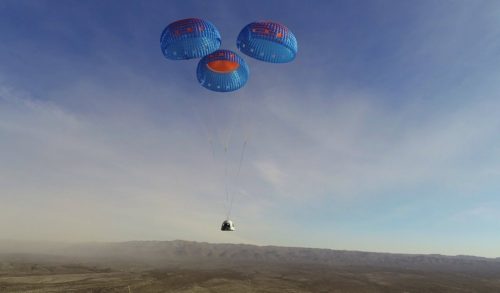
** Jan.14: Blue Origin flew the fourth New Shepard vehicle for the first time on Thursday, January 14th at the company’s facility in West Texas.This vehicle includes additional design changes and will be used for the first flights with people on board. Mission NS-14 successfully demonstrates crew capsule upgrades – Blue Origin

The crew capsule descends for a landing after reaching over 100 kilometers in altitude. Credits: Blue Origin

Mission NS-14 featured a crew capsule outfitted with astronaut experience upgrades for upcoming flights with passengers onboard. Capsule upgrades included:

    • Speakers in the cabin with a microphone and a push-to-talk button at each seat so astronauts can continuously talk to Mission Control.
    • First flight of the crew alert system with a panel at each seat relaying important safety messages to passengers.
    • Cushioned wall linings and sound suppression devices to reduce ambient noise inside the capsule.
    • Environmental systems, including a cooling system and humidity controls to regulate temperature and prevent capsule windows from fogging during flight, as well as carbon dioxide scrubbing.
    • Six seats.

Also today during ascent, the booster rotated at 2-3 degrees per second. This is done to give future passengers a 360-degree view of space during the flight.

This flight continued to prove the robustness and stability of the New Shepard system and the BE-3PM liquid hydrogen/liquid oxygen engine.

Also onboard today were more than 50,000 postcards from Blue Origin’s nonprofit Club for the Future. The Club has now flown over 100,000 postcards to space and back from students around the world. More information here.

** Blue reportedly plans to fly the  first New Shepard mission with people on board in early spring: Jeff Bezos’ Blue Origin aims to fly people on New Shepard by April – CNBC

Beyond the upgrades, CNBC has learned that NS-14 also marked one of the last remaining steps before Blue Origin flies its first crew to space.

The flight was the first of two “stable configuration” test flights, people familiar with Blue Origin’s plans told CNBC. Stable configuration means that the company plans to avoid making major changes between this flight and the next.

Additionally, those people said that Blue Origin aims to launch the second test flight within six weeks, or by late February, and the first crewed flight six weeks after that, or by early April.

Blue Origin’s next flight, NS-15, will also include a test of loading and unloading the crew, the people said.

The company did not verify this info but it clearly sounds quite plausible.

** Video tour of Blue Origin’s engine production facility in Huntsville, Alabama. During the webcast of the above New Shepard test, a video tour of the company’s engine facility in Huntsville was shown.

** Blue releases video of long duration, full-thrust firing of BE-4 engine: Jeff Bezos released the video on Instagram:

“Perfect night! Sitting in the back of my pickup truck under the Moon and stars watching another long duration, full thrust hotfire test of @BlueOrigin’s BE-4 engine. #GradatimFerociter

The BE-4 will power the first stages of Blue’s New Glenn rocket and ULA’s Vulcan.

More about the BE-4 status: Jeff Bezos kicks back with a BE-4 rocket engine test in Texas – GeekWire.

Scott Manley reviews all of the engines developed so far by Blue:

Blue Origin has been around longer than SpaceX, but they’re a lot more secretive about their technology and the things they’ve built. I wanted to make an overview of the 6 different rocket engines they’re designed and tested and the vehicles that have been propelled by them.

** Jan.19: Chinese Long March 3B rocket takes communications satellite into orbit from the Xichang Satellite Launch Center in the Sichuan province. The third of the Tiantong-1 series of S-Band mobile communications services satellite will move into a geostationary orbital slot.

Continue reading Space transport roundup – Feb.1.2021

Space transport roundup – Jan.10.2021

A sampling of recent articles, videos, and images dealing with space transport (find previous roundups here):

** Jan.8: SpaceX launches Falcon 9 to send Türksat 5A comm-sat into geostationary transfer orbit. The liftoff from Cape Canaveral was the first SpaceX launch of 2021. The booster, on its fourth flight, landed successfully on a floating platform. The Airbus-built satellite will use electric propulsion to circularize its orbit and move to its allocated slot in GEO.

Find more about other SpaceX activities below.

** Dec.29: Arianespace Soyuz launched a French reconnaissance satellite from the Guiana Space Centre in French Guiana. The Soyuz Flight VS25 was the final mission for Arianespace in 2020.

For its 10th and final launch of the year — and the fifth in 2020 with the Soyuz medium launcher — Arianespace will send the CSO-2 Earth observation satellite, intended for defense and security applications, into Sun-synchronous orbit.

CSO-2 will be launched for the French CNES (Centre National d’Etudes Spatiales) space agency and the DGA (Direction générale de l’armement) defense procurement agency on behalf of the French Ministry of Defense

It also will be the 25th mission carried out by Soyuz from French Guiana since it began operating at the Guiana Space Center (CSG) in October 2011.

More at:

** Dec.27: Long March 4C launched a reconnaissance satellite:

** Dec. 22: China’s new Long March 8 rocket launched on first flight from the Wenchang Space Launch Center in the South China island province of Hainan. Unlike most of the other Long March rockets, the medium-lift LM8 uses all non-toxic liquid propellants. The long term plan is to implement the vehicle with reusable boosters.

From NSF:

The LM-8 can launch a 5,000 kg cargo to an SSO 700 km orbit, an 8,400 kg cargo to LEO, or 2,800 kg to GTO.

In future missions, the first stage will be reusable (the LM-8R), which features powered vertical landing with deployable landing legs. The strap-on boosters will stay attached for landing.

Also, in the future, the LM-8 may be launched without the side boosters (the LM-8A version).

A video about the reusability plan:

The Long March-8 launch vehicle will be reusable, according to Song Zhengyu, chief designer of the Long March-8 rocket. The first launch of the Long March-8 launch vehicle (Long March-8 Y1) took place from the Wenchang Space Launch Center Hainan Province, China, on 22 December 2020, at 04:37 UTC (12:37 local time). Credit: China Central Television (CCTV)/China National Space Administration (CNSA)

** Dec.18: Russia/Arianespace Soyuz rocket launched 36 OneWeb satellites from Vostochny Cosmodrome, Russia.

** Dec. 17: India launched a comm-sat on PSLV rocket:

https://youtu.be/WTEMlT2IFTg

** Jan.6: Northrop-Grumman Cygnus cargo vehicle departs from the ISS. The vehicle arrived there after launching on Oct. 2, 2020 aboard a NG Antares rocket from the spaceport at Wallops Island, Virginia.

** SpinLaunch is expanding facilities and operations at NM spaceport. The first tests of the centrifugal catapult style launch system to start in 2021. SpinLaunch Plans Major Expansion at Spaceport America | Spaceport America

SpinLaunch signed a lease at Spaceport America in 2019 and has since invested in test facilities and an integration facility. The company is now set to hire an additional 59 highly-paid workers and complete the build of its suborbital centrifugal launch system for its next phase of development. SpinLaunch expects to start test launches in New Mexico in 2021.

The company, expected to spend $46 million of private money in construction and expansion over 10 years, will generate an economic impact of $239 million over that period of time statewide.

SpinLaunch founder Jonathan Yaney said the technology behind the company is a cleaner and more affordable way to reach orbit.

“Our technology enables a 10 times reduction in the current costs and complexities of reaching orbit. As the number of rocket launches rapidly increases, SpinLaunch uniquely reaches space without releasing pollutants into critical layers of the atmosphere. We’re satisfying both the economic and environmental demands of a space industry experiencing exponential growth. This is the first time in human history we have an alternative to rockets,” Yaney said.

See also:

** Blue Origin to deliver operational BE-4 engines for ULA’s new Vulcan rocket by this summer. Bezos’ Blue Origin to deliver first flight-ready rocket engines next summer – ULA CEO | Reuters

The installation of Blue Origin’s reusable BE-4 engines into ULA’s next-generation Vulcan rocket will keep it on track for the debut launch of a moon lander dubbed Peregrine at the end of 2021, ULA Chief Executive Tory Bruno said. The Vulcan rocket has won a slate of key U.S. defense missions through 2027.

Currently, ULA is using “pathfinder”, i.e. non-operational prototype, engines to check that they fit and connect properly into the new Vulcan rocket first stage booster.

** China’s Deep Blue Aerospace test reusable booster prototype for small orbital rocket:

The linked article is translated by Google as Deep Blue Aerospace’s “Vertical Recovery” is ready to go | “Nebula-M” Test Arrow 1 completes the launching joint training and enters the static ignition preparation stage.

** Briefs:

==================

Check out the
The Lurio Report
for news and analysis of key developments in NewSpace

The latest issue:
Axiom, Masten, Starship, Crew-1
Vol. 15, No. 7, November 21, 2020

Space Frontier Foundation Award for NewSpace Journalism

==================

** SpaceX:

*** “Transporter 1” is the next Falcon 9 launch and is set for January 14th. It will be the first of SpaceX’s dedicated “Rideshare” missions. The Rideshare program will provide regularly scheduled launches on which multiple smallsats from different companies and organizations can fly. This first launch is to sun-synchronous orbit and the company is aiming for SSO missions every 4 months. Launches to other inclinations will also be available.

Some smallsats have been withdrawn from this mission:

SpaceX is taking advantage of the extra room to include 10 Starlink satellites: FCC grants permission for polar launch of Starlink satellites – SpaceNews. (See also this FCC pdf doc.)

There are also two Starlink missions planned for January. SpaceX aims to achieve about a launch per week in 2021.

*** SpaceX cargo Dragon set to leave ISS on Monday Jan.11th: NASA to Air Departure of SpaceX Cargo Dragon from Space Station | NASA

The SpaceX Dragon that arrived to the International Space Station on the company’s 21st resupply services mission for NASA is scheduled to depart on Monday, Jan. 11, loaded with 5,200 pounds of scientific experiments and other cargo. NASA Television and the agency’s website will broadcast its departure live beginning at 9 a.m. EST.

The upgraded Dragon spacecraft will execute the first undocking of a U.S. commercial cargo craft from the International Docking Adapter at 9:25 a.m., with NASA astronaut Victor Glover monitoring aboard the station.

Dragon will fire its thrusters to move a safe distance from the station’s space-facing port of the Harmony module, then initiate a deorbit burn to begin its re-entry sequence into Earth’s atmosphere. Dragon is expected to make its parachute-assisted splashdown around 9 p.m. – the first return of a cargo resupply spacecraft in the Atlantic Ocean. The deorbit burn and splashdown will not air on NASA TV.

*** Payload owners are now comfortable with flying on Falcon 9 rockets with used boosters: Gwynne Shotwell talks about selling flight-proven rockets, Starship | Ars Technica

Unless a customer has a strong argument one way or the other, the decision on what booster to use is left up to SpaceX. “You’re buying a launch service, and we will provide you the best vehicle that we can in the timeframe that you need to fly,” [SpaceX president and COO, Gwynne Shotwell] said. “And we basically put the control for the most part in our hands.”

In truth, Shotwell said, it has not been particularly difficult to convince customers to fly on flight-proven rockets. It has been easier to sell customers on the technology than it was selling them on the first Falcon 1 and Falcon 9 rockets. This is because, with rockets, SpaceX has achieved what it said it would do—develop and fly low-cost, reliable launchers.

“It was easier to sell ‘flight proven’ to customers than it was to sell Falcons,” she said. “Obviously, people come to trust organizations and people to do what they say they’re going to do, when you demonstrate that kind of history. So we said we would get to orbit with Falcon 1, and we did. We said we’d get to orbit with Falcon 9, and we did. We said we’d get to Station, and we did. So the sales pitch became much less difficult.”

*** Dec. 19: Last Falcon 9 launch of 2020 sent NROL-108 spysat into orbit. The booster returned for a successful landing at Cape Canaveral.

*** Other SpaceX news:

*** Starship

According to road closings and other indicators, a flight of the SN9 Starship prototype will be attempted in the upcoming week. Presumably, it will be a repeat of the SN8 flight with a max altitude around 12 kilometers. The SN9, with damaged fins replaced, rolled to the launch site on Dec. 22nd. On January 6th, a static firing took place, which appeared to stop prematurely. Another test appeared planned for the following day but it was aborted  mid-way through the pre-test preparations.

**** Starship Wranglers: SN9 Rolls Out for FlightCosmic Perspective

Cameras were rolling during the SpaceX Starship SN9 transport from the production facility to the test stand, capturing some of the amazing humans making Starship happen.

**** Starship SN9 Rollout in 180 3D Stereoscopic VRCosmic Perspective

Cameras were rolling during the SpaceX Starship SN9 transport from the production facility to test stand, including our 180-degree 3D stereoscopic camera rig for Virtual Reality headsets like Oculus Quest.

**** Super Heavy Booster may settle onto launch tower arms, according to a Tweet from Elon:

While it seems far-fetched at first hearing, it really is not so unreasonable when one thinks about it. After the learning phase, the Falcon 9 boosters have either set down within the target circles on the landing pads or have been far off the mark. I don’t remember any landing in the past few years that has been close to the edge of a pad. Bad landings, such as the time a booster went into the water off the beach at Cape Canaveral, are caused by failures (typically an engine issue) that occur with enough time margin to insure the rocket hits far away from the pad.

So landing within a circle defined by the arms on the launch tower rather than paint on a pad is clearly doable. With thousands of landings, there is, of course, still the likelihood of a rare near miss happening at some point. Additional launch towers offer redundancy and the towers  can be toughened to minimize the cost of repair, which should be far less than the gains obtained from the greater mass reaching orbit with the elimination of landing legs.

Note also that when the rocket lands, the propellants are nearly gone so the vehicle will be at its lightest. This will reduce the stress on the grid fins and their joints.

More at

**** Some comments from Elon Musk on Starship/Super Heavy test plans:

**** Status of the preparation of various vehicles as of January 9th is nicely displayed in this terrific graphic:

**** SpaceX releases video of SN8 highlights: Starship | SN8 | High-Altitude Flight Recap – SpaceX –

On December 9, 2020, Starship serial number 8 (SN8) completed a high-altitude flight test as it successfully ascended, transitioned propellant, and demonstrated a first-of-its-kind controlled aerodynamic descent and landing flip maneuver – which will enable landing where prepared surfaces or runways do not exist, including the Moon, Mars, and beyond.

**** Starship SN8 Flight: The Mini Documentary  – Cosmic Perspective – A very nicely done mini-doc about the SN8 flight and the people on-site observing it.

On December 9, SpaceX successfully launched Starship SN8 on its first-ever high-altitude test flight to 12.5 km (41,000 ft). We and the crowds at South Padre Island lost our minds. We also made lots of new friends, especially Gene and Rachel of Spadre.com, long-time Starship documenters, and wonderful passionate humans we very much look up to. On launch day, as part of the @Everyday Astronaut livestream team, we used a joystick-controlled telescope and a series of high-speed cameras (including one of the most epic anamorphic shots ever) to record the moment of liftoff and track the rocket through its unbelievable belly-flop maneuver and landing attempt. So grateful to Tim, Gene and Rachel for an amazing adventure witnessing, documenting, and sharing this historic event. Everything has changed.

**** Extracting propellants and other resources from Mars for Starship missions is described by Marcus House.

Weeks ago Elon Musk said “Rapid & complete rocket reuse, low-cost propellant, orbital refilling & propellant production at destination are the four essential elements of making life multi-planetary”. Today we are diving deep into how In Situ Resource Utilisation plays a vital role as humankind ventures out from our homeworld. Why is it so critical for SpaceX’s plans to have humans settle permanently on Mars? What resources can be used in the meantime on the surface of the moon? Let’s find out.

**** Jan.2SpaceX Boca Chica Flyover, Starship SN9 Awaits Static FireRGV Aerial Photography

****  Jan. 6: SN8 & SN9 Static Fire Comparison With Slo-Mo ReplayLabPadre – YouTube

This video edit shows a comparison at SpaceX Boca Chica, Texas of Starship SN8 and SN9 static fires. You can see the similarities and differences in the Slo-Mo replay. SN8 #1 and SN9 #1 both detanked almost immediately after ignition indication a possible problem. SN8 #2 and #3 both seemed like good fires but #2 did have a significant amount of ejecta. Audio is from SN9 static fire.

****Jan. 6-8: SpaceX SN9 Starship Boca Chica 2021 January 6, 7, 8 Prep for Static Fire [4K]StarshipBocaChica/Maria Pointer – YouTube

Maria documents the first efforts of the New Year to get SN9 in the air. Join her for the sights and sounds of the Production Shipyard and SN9 on Sub-Orbital Launch Pad B.

**** Jan.8: SpaceX Boca Chica: Raptor Engine SN45 Delivered – Starship SN15 Gets Thermal Protection TilesNASASpaceflight – YouTube

Work continues to prep SN9 for flight above Boca Chica. Meanwhile, a new Raptor engine is delivered and SN15 gets thermal protection tiles in preparation for stacking. Video & Photos from Mary (@BocaChicaGal). Edited by Theo Ripper (@TheoRipper)

**** Jan.9: SpaceX Boca Chica: Fresh Propellant Arrives Before SN9’s Next Static Fire AttemptNASASpaceflight – YouTube

After an aborted static fire attempt, SpaceX replenishes the tank farm with a fresh delivery of propellant for SN9. Meanwhile, SN10 work continues and the new upgraded Starship, SN15, begins to take shape. Video & Photos from Mary (@BocaChicaGal). Edited by Nicholas Gautschi (@NGautschi)

*** Other reports:

**** Jan.9 SpaceX Starship next flight to 41,000ft (12.5km) – Bellyflop #2 Marcus House

Well, here we are in the final leadup to the SpaceX Starship next flight to 41,000ft (12.5km). This will be Bellyflop #2 with what we hope will be a successful landing this time around. The dizzying speed of SN9’s preparations for its test flight continued this week, as did the amazing build progress with various sections of several Starship versions spotted. It’s also almost time for the first Cargo Dragon version 2 (CRS-21) to come home after the fully autonomous capsule docked with the International Space Station on December 7 last year. We had the first Falcon 9 launch of 2021 with the Turksat 5A mission, and we also take a look back at the Mars Spirit and Opportunity Rovers that landed on the red planet seventeen years ago. An amazing mission to look back on as we await the arrival of Perseverance in just a few weeks now.

** Dec.27: SpaceX MMXX (2020) Tribute – One Step Ahead – What about it!?

SpaceX has been a light beacon to all of us in 2020. Leading the space industry by achieving milestone after milestone. With Crew Dragon and the Starship Prototype program they have inspired millions of humans across the globe. Here’s to SpaceX and our future as a multi planetary species.

=== Amazon Ads ===

Space Is Open for Business:
The Industry That Can Transform Humanity

=====

America’s New Destiny in Space