Ocean Worlds: New details on sub-surface water in moons of Saturn and Jupiter

NASA today presented new results from studies of the water plumes emitted from underground seas of Saturn’s moon Enceladus and Jupiter’s moon Europa. The new NASA website Ocean Worlds describes these moons and the many other objects in our solar system, including large asteroids and Mars, that also have significant amounts of sub-surface water.

NASA Missions Provide New Insights into ‘Ocean Worlds’ 

Two veteran NASA missions are providing new details about icy, ocean-bearing moons of Jupiter and Saturn, further heightening the scientific interest of these and other “ocean worlds” in our solar system and beyond. The findings are presented in papers published Thursday by researchers with NASA’s Cassini mission to Saturn and Hubble Space Telescope.

This illustration [Larger version] shows Cassini diving through the Enceladus plume in 2015. New ocean world discoveries from Cassini and Hubble will help inform future exploration and the broader search for life beyond Earth. Credits: NASA/JPL-Caltech
In the papers, Cassini scientists announce that a form of chemical energy that life can feed on appears to exist on Saturn’s moon Enceladus, and Hubble researchers report additional evidence of plumes erupting from Jupiter’s moon Europa.

“This is the closest we’ve come, so far, to identifying a place with some of the ingredients needed for a habitable environment,” said Thomas Zurbuchen, associate administrator for NASA’s Science Mission Directorate at Headquarters in Washington. ”These results demonstrate the interconnected nature of NASA’s science missions that are getting us closer to answering whether we are indeed alone or not.”

The paper from researchers with the Cassini mission, published in the journal Science, indicates hydrogen gas, which could potentially provide a chemical energy source for life, is pouring into the subsurface ocean of Enceladus from hydrothermal activity on the seafloor.

This graphic illustrates how Cassini scientists think water interacts with rock at the bottom of the ocean of Saturn’s icy moon Enceladus, producing hydrogen gas. Credits: NASA/JPL-Caltech Full image and caption

The presence of ample hydrogen in the moon’s ocean means that microbes – if any exist there – could use it to obtain energy by combining the hydrogen with carbon dioxide dissolved in the water. This chemical reaction, known as “methanogenesis” because it produces methane as a byproduct, is at the root of the tree of life on Earth, and could even have been critical to the origin of life on our planet.

Life as we know it requires three primary ingredients: liquid water; a source of energy for metabolism; and the right chemical ingredients, primarily carbon, hydrogen, nitrogen, oxygen, phosphorus and sulfur. With this finding, Cassini has shown that Enceladus – a small, icy moon a billion miles farther from the sun than Earth – has nearly all of these ingredients for habitability. Cassini has not yet shown phosphorus and sulfur are present in the ocean, but scientists suspect them to be, since the rocky core of Enceladus is thought to be chemically similar to meteorites that contain the two elements.

“Confirmation that the chemical energy for life exists within the ocean of a small moon of Saturn is an important milestone in our search for habitable worlds beyond Earth,” said Linda Spilker, Cassini project scientist at NASA’s Jet Propulsion Laboratory (JPL) in Pasadena, California.

The Cassini spacecraft detected the hydrogen in the plume of gas and icy material spraying from Enceladus during its last, and deepest, dive through the plume on Oct. 28, 2015. Cassini also sampled the plume’s composition during flybys earlier in the mission. From these observations scientists have determined that nearly 98 percent of the gas in the plume is water, about 1 percent is hydrogen and the rest is a mixture of other molecules including carbon dioxide, methane and ammonia.
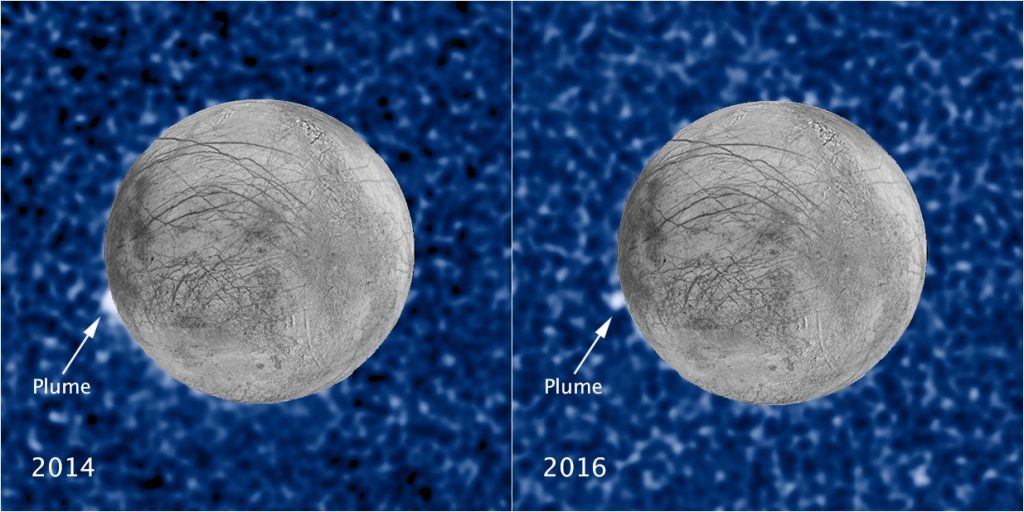
These composite images show a suspected plume of material erupting two years apart from the same location on Jupiter’s icy moon Europa. Both plumes, photographed in UV light by Hubble, were seen in silhouette as the moon passed in front of Jupiter. Credits: NASA/ESA/STScI/USGS. Full image and caption

The measurement was made using Cassini’s Ion and Neutral Mass Spectrometer (INMS) instrument, which sniffs gases to determine their composition. INMS was designed to sample the upper atmosphere of Saturn’s moon Titan. After Cassini’s surprising discovery of a towering plume of icy spray in 2005, emanating from hot cracks near the south pole, scientists turned its detectors toward the small moon.

Cassini wasn’t designed to detect signs of life in the Enceladus plume – indeed, scientists didn’t know the plume existed until after the spacecraft arrived at Saturn.

“Although we can’t detect life, we’ve found that there’s a food source there for it. It would be like a candy store for microbes,” said Hunter Waite, lead author of the Cassini study.

The new findings are an independent line of evidence that hydrothermal activity is taking place in the Enceladus ocean. Previous results, published in March 2015, suggested hot water is interacting with rock beneath the sea; the new findings support that conclusion and add that the rock appears to be reacting chemically to produce the hydrogen.
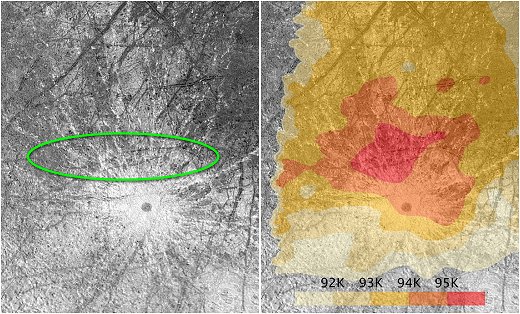
The green oval highlights the plumes Hubble observed on Europa. The area also corresponds to a warm region on Europa’s surface. The map is based on observations by the Galileo spacecraft. Credits: NASA/ESA/STScI/USGS Full image and caption

The paper detailing new Hubble Space Telescope findings, published in The Astrophysical Journal Letters, reports on observations of Europa from 2016 in which a probable plume of material was seen erupting from the moon’s surface at the same location where Hubble saw evidence of a plume in 2014. These images bolster evidence that the Europa plumes could be a real phenomenon, flaring up intermittently in the same region on the moon’s surface.

The newly imaged plume rises about 62 miles (100 kilometers) above Europa’s surface, while the one observed in 2014 was estimated to be about 30 miles (50 kilometers) high. Both correspond to the location of an unusually warm region that contains features that appear to be cracks in the moon’s icy crust, seen in the late 1990s by NASA’s Galileo spacecraft. Researchers speculate that, like Enceladus, this could be evidence of water erupting from the moon’s interior.

“The plumes on Enceladus are associated with hotter regions, so after Hubble imaged this new plume-like feature on Europa, we looked at that location on the Galileo thermal map. We discovered that Europa’s plume candidate is sitting right on the thermal anomaly,” said William Sparks of the Space Telescope Science Institute in Baltimore, Maryland. Sparks led the Hubble plume studies in both 2014 and 2016.

The researchers say if the plumes and the warm spot are linked, it could mean water being vented from beneath the moon’s icy crust is warming the surrounding surface. Another idea is that water ejected by the plume falls onto the surface as a fine mist, changing the structure of the surface grains and allowing them to retain heat longer than the surrounding landscape.

For both the 2014 and 2016 observations, the team used Hubble’s Space Telescope Imaging Spectrograph (STIS) to spot the plumes in ultraviolet light. As Europa passes in front of Jupiter, any atmospheric features around the edge of the moon block some of Jupiter’s light, allowing STIS to see the features in silhouette. Sparks and his team are continuing to use Hubble to monitor Europa for additional examples of plume candidates and hope to determine the frequency with which they appear.

NASA’s future exploration of ocean worlds is enabled by Hubble’s monitoring of Europa’s putative plume activity and Cassini’s long-term investigation of the Enceladus plume. In particular, both investigations are laying the groundwork for NASA’s Europa Clipper mission, which is planned for launch in the 2020s.

“If there are plumes on Europa, as we now strongly suspect, with the Europa Clipper we will be ready for them,” said Jim Green, Director of Planetary Science, at NASA Headquarters.

Hubble’s identification of a site which appears to have persistent, intermittent plume activity provides a tempting target for the Europa mission to investigate with its powerful suite of science instruments. In addition, some of Sparks’ co-authors on the Hubble Europa studies are preparing a powerful ultraviolet camera to fly on Europa Clipper that will make similar measurements to Hubble’s, but from thousands of times closer. And several members of the Cassini INMS team are developing an exquisitely sensitive, next-generation version of their instrument for flight on Europa Clipper.

For more information on ocean worlds in our solar system and beyond, visit: https://www.nasa.gov/specials/ocean-worlds
Space Art: “Why we need space artists” + An “Inner Telescope” on the ISS + Expressing ourselves through space exploration

Three space art related items:

** Why We Need Space Artists – Room: The Space Journal – In this  brief intro to space art, David A. Hardy, a well noted space artist himself, explains why the artist’s view will always be needed even after there are high-res photos of a celestial place.

In the BBC six o’clock news of 15 July 2015, as a result of the first New Horizons images, several paintings of Pluto were shown (some by myself) with the statement, ‘There is no longer any need for artists’ impressions.’ This comment was of course intended to be whimsical but, as the public sees it, there is an element of truth in it. We have after all now received images from all of the major bodies in our Solar System.

There will always be a need for artists (quite apart from the aesthetic aspects; space art can be at least as beautiful as terrestrial art) because from space probes we only see the whole object – planet, moon, comet – or close-ups of it, as it looks from space. Only artists can visualise what it would look like for someone actually standing on the surface. Of course, we heard the same sort of comments when photography was invented, when digital art became available, when the Hubble Space Telescope sent back its first amazing images of distant stars and nebulae. . . But let’s take a look at the history and background of space art.

[]
“From Moon To Mars” by David A. Hardy

** A Space Odyssey: Making Art Up There – The New York Times – French astronaut Thomas Pesquet, currently lives on the International Space Station. In February, he took a break from his usual work load:

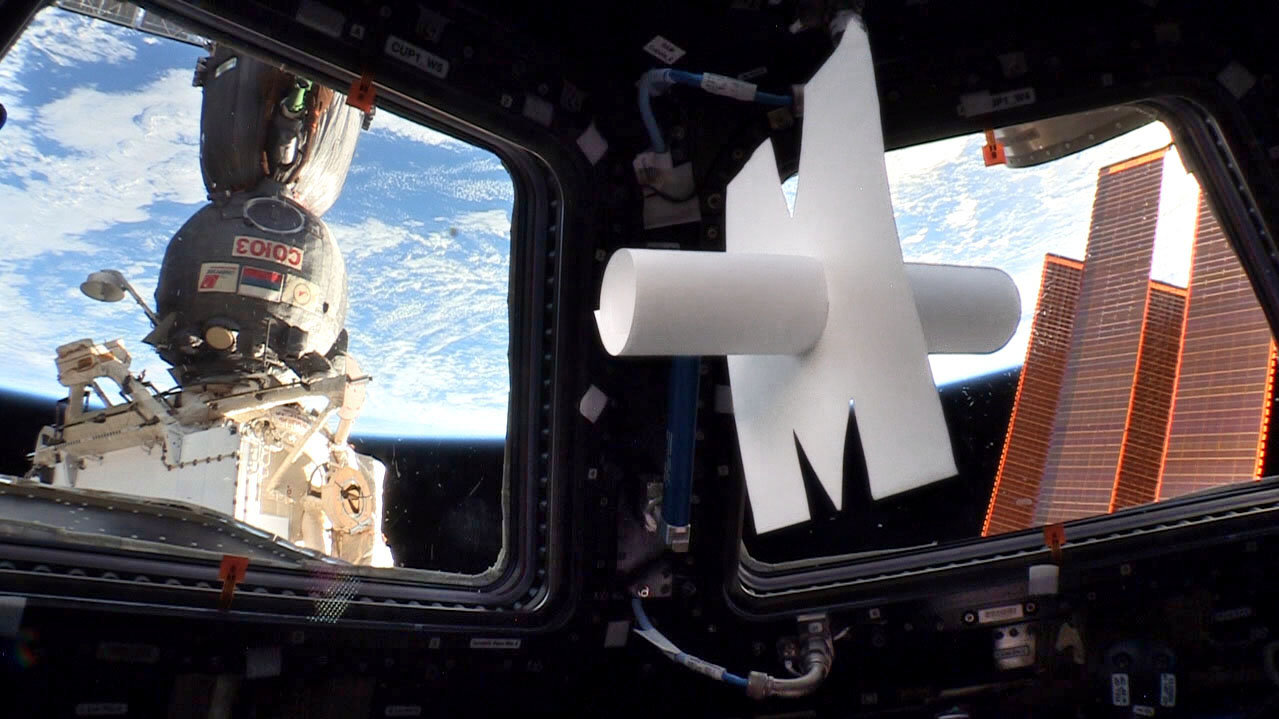
… there was a more unusual item on Mr. Pesquet’s agenda. Working with the earthbound artist Eduardo Kac, he created an artwork in space. It was a simple piece: nothing more than could be done with two sheets of paper and a pair of scissors. “Since the goal was to be born in space, it had to be created with materials that were already in the space station,” Mr. Kac (pronounced katz) explained in a telephone interview from his home in suburban Oak Park, Ill. Transporting art materials by rocket ship was not in the plan.

“Inner Telescope” floats in the ISS Cupola.

The artwork — a piece of paper cut into an M, and another piece of paper rolled into a tube and stuck through the middle of the M — might look a bit silly on Earth, where gravity would accentuate its flimsiness. But floating weightlessly in the space station, it looks fragile, even magical — not unlike the planet beyond.

Viewed with a certain amount of imagination, the paper construction can be said to spell “moi.” Mr. Kac, a professor of art and technology at the School of the Art Institute of Chicago, means this not as an individual “me” but in the collective sense: His “moi” stands for all of us. The piece itself is called “Inner Telescope,” for reasons that become clear only when you look through the O formed by the paper tube and view a tiny portion of Earth. “We point a telescope to the stars,” he said. “But this is a telescope that from the stars we point to ourselves.”

The project was supported by the L’Observatoire de l’Espace (The Space Observatory).

Here is a video about the project. (It is in French but you can obtain rough translated captions via Settings -> Subtitles/CC -> Language selection. Then click on the CC control.)

** Extraterrestrial culture: How we express ourselves through space exploration | The Planetary Society – Theater scholar Felipe Cervera writes about how “extraterrestrial space” is  expressed in our culture.

Humankind has practiced outer space—that is, we have performed it—since time immemorial. Through science, philosophy and the arts, we have practiced extraterrestrial culture since the first time we took a star as a reference to life on Earth—Ptolemy, Copernicus and Galileo were all already practicing extraterrestrial culture. However, today extraterrestrial culture acquires a much more material potential. In an age of climate change and orbital trash, of planetary stewardship and satellite telecommunication, of interplanetary colonialism and orbital cosmopolitanism, the performativity of our extraterrestrial culture is no longer exclusively a projection for the future, but rather the pressing expression of the material relationality between us, our planet, and with the universe at large. How we enact space now is therefore a determinant factor in the ways in which we will continue to practice space in the future.

And how would he like to express extraterrestrial space?

Myself? I want to stage Waiting for Godot in orbit, and have Neil deGrasse Tyson and Bill Nye play Vladimir and Estragon. The play is a seminal work in the history of theatre in general, and an exemplary case of a genre called “theatre of the absurd.” This particular genre’s main characteristics are that the storyline is often circular and the characters live through a cyclical, almost nonsensical existence. In Waiting for Godot, Vladimir and Estragon spend the entire play waiting for Godot, whose complete identity we never really learn and who actually never shows up. The play has often been interpreted as a poetic representation of humans’ existential agony, and the search for a meaning in a world that may not have one at all. The end of the play encapsulates this:

Estragon (Neil): Well? Shall we go?

Vladimir (Bill): Yes, let’s go.

They don’t move.

Imagine Neil deGrasse Tyson and Bill Nye playing these characters and saying these lines…in orbit…on board the ISS…wouldn’t that be something?

====

Philip K. Dick Science Fiction Festival – NYC, May 25-30, 2017

The Philip K. Dick Science Fiction Film Festival
Announces Fifth Anniversary Event

Over 100 Film Screenings, Premieres and Events Will Be Held
May 25-30, 2017 
— Festival Launches New Special Guest Panel Series PKD Talks: 
Conversations with Luminaries, Visionaries and Mavericks —

(New York City, N.Y.) April 13, 2017 — The Philip K. Dick Science Fiction Film Festival has announced the full lineup for its fifth annual event from May 25-30, 2017. This year’s anniversary program will spotlight over 100 films, exclusive premieres, discussions, virtual reality demonstrations and celebratory gatherings as the festival continues its everlasting tribute to the master of science fiction, Philip K. Dick.

For the past five years, The Philip K. Dick Science Fiction Film Festival has exhibited quality independent sci-fi for audiences who crave new innovative pathways of expression. The festival supports freethinking filmmakers equipped with the knowledge of our world, brave enough to see beyond the barriers of existence and who give to an art form that unites the masses.

Daniel Abella, the founder and director of the festival, enthused about this year’s milestone event and the high-caliber official selections.

“I am very excited to present this year’s fifth annual festival in our home of New York City. The lineup includes films from throughout the world and represents talent across all backgrounds and beliefs.” Abella added, “Science fiction continues to entertain but also inform us about current and future trends and it is our mission to bring together likeminded people tied by a common purpose to remain human in a world of progressive dehumanization.”

While praising the works and prophecies of the festival’s namesake, Abella said,

“Philip K. Dick’s message is that in spite of forces marshaled against the human spirit, both political and technological, humanity can prevail if we find the will and determination to pave a better future. This festival represents his voice.”

=

2017 NASA Student Launch competition results

Here is a report on the NASA Student Launch competition, which includes middle school through college level teams, which took place last week. (I included videos posted by some of the teams.)

NASA Announces Preliminary Award Winners
for 2017 Student Launch

After a day of rocket launches during the 2017 Student Launch, NASA announced the challenge’s preliminary winners April 8 at an awards ceremony hosted by Orbital ATK Aerospace Group of Promontory, Utah, at the U.S. Space & Rocket Center in Huntsville, Alabama.

Fifty middle and high school, college and university teams from 23 states launched their student-built rockets at Bragg Farms in Toney, Alabama, near NASA’s Marshall Space Flight Center.

Participating in the Student Launch challenge, student teams demonstrated advanced aerospace and engineering skills as they launched their rockets to an altitude of 1 mile, deployed an automated parachute system and landed the rocket safely for reuse.

The University of Notre Dame won the 2017 Student Launch Altitude Award in the college division with an altitude of 5,286 feet, only 6 feet above challenge’s 1-mile goal. Notre Dame’s launch was the closest to the goal in Student Launch’s 17-year history. Credits: NASA/MSFC/Fred Deaton

The event was the culmination of eight months of work for students, during which the teams built and tested their rockets and completed a series of technical reviews mirroring criteria in NASA’s engineering design lifecycle and safety protocol.

Now in its 17th year, Student Launch included a visit from NASA astronaut Kate Rubins, a member of the International Space Station’s Expedition 48/49 crew; a behind-the-scenes tour of Marshall facilities; and a rocket fair, where students showcased their rocket designs to NASA team members, corporate sponsor Orbital ATK and the public.

Fifty student teams competed in NASA’s Student Launch April 8, near the agency’s Marshall Space Flight Center. Teams from 23 states launched their student-built rockets from Bragg Farms in Toney, Alabama. [Larger image] Credits: NASA/MSFC/Charles Beason
Marshall’s Academic Affairs Office manages Student Launch, to further NASA’s major education goal of attracting and encouraging students to pursue degrees and careers in the STEM fields of science, technology, engineering and mathematics. NASA’s Office of Education and Human Exploration and Operations Mission Directorate, as well as Orbital ATK’s Propulsion Systems Division and the Huntsville chapter of the National Space Club, provide funding and leadership for the initiative.

2017 Student Launch Preliminary Award Winners

  • Best Vehicle Design Award, presented to the team with the most creative, innovative and safety-conscious overall rocket design: University of Louisville, Kentucky
  • Safety Award, presented to the team that most successfully maximized safety and science value in their design: Cornell University, Ithaca, New York
  • Project Review Award: presented to the team with the best combination of written reviews and formal presentations: Cornell University
  • Education Engagement Award, presented to the team that best informed others about rocketry and other space-related topics:
    Vanderbilt University, Nashville, Tennessee
  • Altitude Award (College Division), presented to the college or university team that came closest the target altitude of 5,280 feet (one mile) above ground level: University of Notre Dame, Notre Dame, Indiana — 5,286 feet
  • Altitude Award (Middle/High School Division), presented to the middle or high school team that came closest the target altitude of 5,280 feet (1 mile) above ground level: Krueger Middle School, San Antonio, Texas — 5,325 feet
  • Payload Design Award, presented to the team with the most creative, and innovative payload design while maximizing safety and science value: Vanderbilt University
  • Best Website Award (College Division), presented to the college or university team with the best, most efficient website:
    Auburn University, Alabama
  • Best Website Award (Middle/High School Division), presented to the middle or high school team with the best, most efficient website: American Institute of Aeronautics and Astronautics of Orange County, Irvine, California
  • Rocket Fair Display Award (College Division), presented to the college or university team that is judged by their peers to have had the best display at the Student Launch Rocket Fair: Vanderbilt University
  • Rocket Fair Display Award (Middle/High School Division), presented to the middle or high school team that is judged by their peers to have had the best display at the Student Launch Rocket Fair: McKinney High School, Texas
  • Best Looking Rocket Award (College Division), presented to the college or university team that is judged by their peers to have had the best looking rocket: Iowa State University, Ames, Iowa
  • Best Looking Rocket Award (Middle/High School Division), presented to the middle or high school team that is judged by their peers to have had the best looking rocket: Engineering and Technologies Academy at Roosevelt School, San Antonio, Texas
  • Team Spirit Award (College Division), presented to the college or university team that is judged by their peers to have had the best team spirit on launch day: U.S. Naval Academy, Annapolis, Maryland
  • Team Spirit (Middle/High School Division), presented to the middle or high school team that is judged by their peers to have had the best team spirit on launch day: Engineering and Technologies Academy at Roosevelt School
  • Judges’ Choice Award, presented to the middle or high school team that is selected by a secret panel of judges to have had the most creative payload, best design and workmanship of their rocket and best engagement with the rocket fair crowd. This includes a $2,000 prize from the National Space Club: Northern Illinois Home School Association, Montgomery, Illinois

The overall winners of Student Launch will be announced in early May, as the final calculations are still under review for accuracy. This will include the first- through third-place teams, as well as the rookie award winner, with the first-place winner receiving a $5,000 prize from sponsor Orbital ATK and the second-place winner receiving a $2,500 prize from the National Space Club.

For more information about NASA’s Student Launch, visit: http://www.nasa.gov/studentlaunch

Archived launch-day footage is available on Marshall’s Ustream account: http://www.ustream.tv/channel/nasa-msfc