The astronauts on the Int. Space Station have fun with a large ball of water and a GoPro camera: ISS Astronauts Encase GoPro In Orb Of Floating Water – Popular Science
Here is the 3D version:
The astronauts on the Int. Space Station have fun with a large ball of water and a GoPro camera: ISS Astronauts Encase GoPro In Orb Of Floating Water – Popular Science
Here is the 3D version:
An announcement from the European Southern Observatory (ESO):
Revolutionary ALMA Image Reveals Planetary Genesis
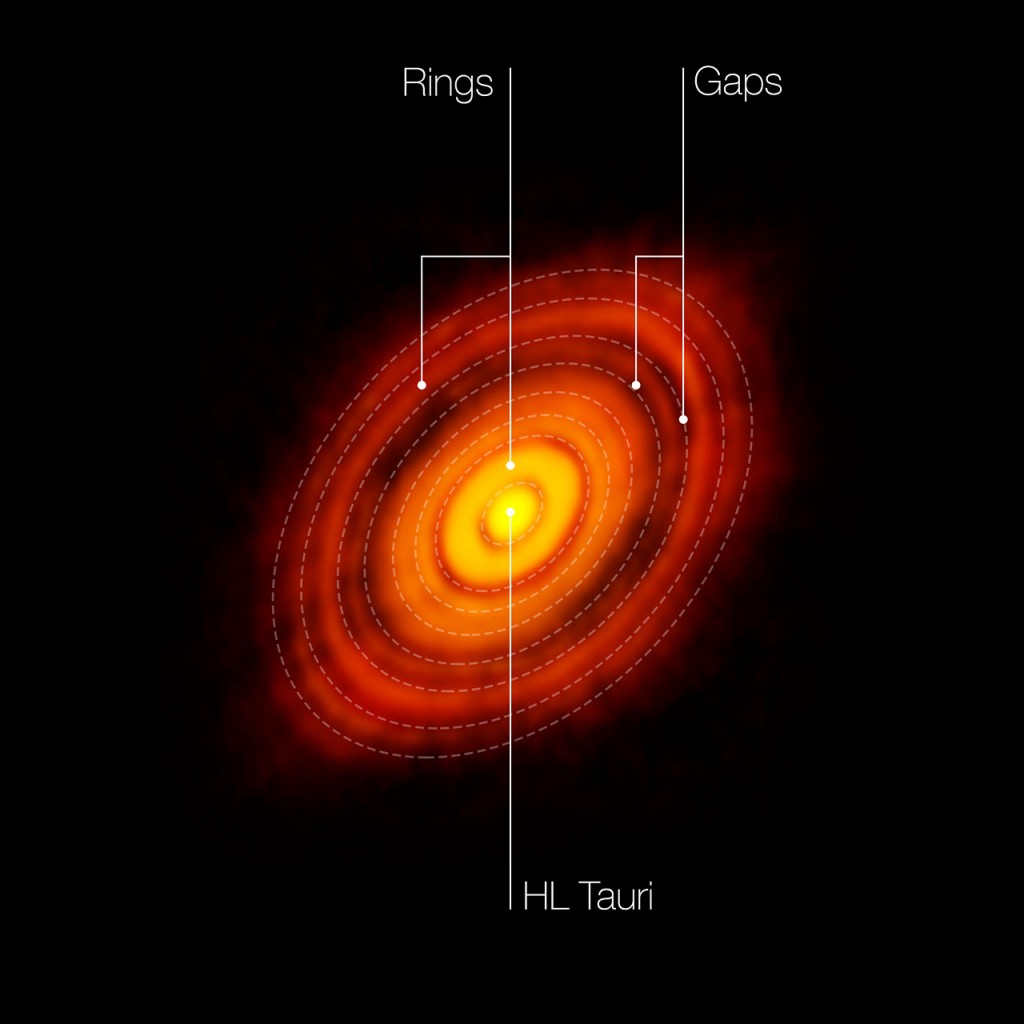
This new image from ALMA, the Atacama Large Millimeter/submillimeter Array, reveals extraordinarily fine detail that has never been seen before in the planet-forming disc around a young star. These are the first observations that have used ALMA in its near-final configuration and the sharpest pictures ever made at submillimetre wavelengths. The new results are an enormous step forward in the observation of how protoplanetary discs develop and how planets form.
For ALMA’s first observations in its new and most powerful mode, researchers pointed the antennas at HL Tauri — a young star, about 450 light-years away, which is surrounded by a dusty disc [1]. The resulting image exceeds all expectations and reveals unexpectedly fine detail in the disc of material left over from star birth. It shows a series of concentric bright rings, separated by gaps [2].
“These features are almost certainly the result of young planet-like bodies that are being formed in the disc. This is surprising since such young stars are not expected to have large planetary bodies capable of producing the structures we see in this image,” said Stuartt Corder, ALMA Deputy Director.
“When we first saw this image we were astounded at the spectacular level of detail. HL Tauri is no more than a million years old, yet already its disc appears to be full of forming planets. This one image alone will revolutionise theories of planet formation,” explained Catherine Vlahakis, ALMA Deputy Program Scientist and Lead Program Scientist for the ALMA Long Baseline Campaign.
HL Tauri’s disc appears much more developed than would be expected from the age of the system. Thus, the ALMA image also suggests that the planet-formation process may be faster than previously thought.
Such high resolution can only be achieved with the long baseline capabilities of ALMA and provides astronomers with new information that is impossible to collect with any other facility, even the NASA/ESA Hubble Space Telescope. “The logistics and infrastructure required to place antennas at such distant locations required an unprecedented coordinated effort by an expert international team of engineers and scientists,” said ALMA Director, Pierre Cox. “These long baselines fulfill one of ALMA’s major objectives and mark an impressive technological, scientific and engineering milestone.”
Young stars like HL Tauri are born in clouds of gas and fine dust, in regions which have collapsed under the effects of gravitation, forming dense hot cores that eventually ignite to become young stars. These young stars are initially cocooned in the remaining gas and dust, which eventually settles into a disc, known as a protoplanetary disc.
Through many collisions the dust particles will stick together, growing into clumps the size of sand grains and pebbles. Ultimately, asteroids, comets and even planets can form in the disc. Young planets will disrupt the disc and create rings, gaps and holes such as those seen in the structures now observed by ALMA [3].
The investigation of these protoplanetary discs is essential to our understanding of how Earth formed in the Solar System. Observing the first stages of planet formation around HL Tauri may show us how our own planetary system may have looked more than four billion years ago, when it formed.
“Most of what we know about planet formation today is based on theory. Images with this level of detail have up to now been relegated to computer simulations or artist’s impressions. This high resolution image of HL Tauri demonstrates what ALMA can achieve when it operates in its largest configuration and starts a new era in our exploration of the formation of stars and planets,” says Tim de Zeeuw, Director General of ESO.
The European Space Agency’s Rosetta spacecraft now orbiting the Comet 67P/Churyumov–Gerasimenko will release its Philae lander to touch down on the comet on November 12th at 08:35 UTC (09:35 CET, 03:35 EST) . They have now chosen the name Agilkia for the landing spot: Farewell ‘J’, hello Agilkia – ESA
 Rosetta & Philae at comet 67P. Credit: ESA–C. Carreau/ATG medialab
On October 31st, Rosetta made a maneuver to align itself for the release of the lander : Rosetta lined up for lander delivery – Rosetta blog.
the next planed orbit-changing manoeuvres will occur on the 12th at (a) 2 hours before separation and (b) about 40 minutes after (see animation below), in between which Philae will be released.
The pre-delivery manoeuvre will shift Rosetta’s trajectory so that the orbiter would be on a path so as to pass over the comet at a distance of 5 km, while the separation will occur at 08:35 UTC on board the spacecraft about 22 km (the confirmation signal will arrive on Earth at 09:03 UTC).
The second manoeuvre will cause a deflection of the Rosetta trajectory away from the comet; it will occur 40 minutes after separation, and help guarantee visibility of Philae at touchdown.
This video shows the orbital path (accelerated in time) of the orbiter
This video is about the landing and the people involved in the project:
Simon Owens writes about an interesting citizen science project at the Harvard-Smithsonian Center for Astrophysics : Why Harvard and the Smithsonian teamed up to crowdsource a century of astronomical history – Simon Owens
The goal of the project is
to transcribe logbooks for nearly half a million photographic plates of the night sky that had been taken over the course of a hundred years.
The project, called Digital Access to a Sky Century at Harvard (DASCH for short), is actually a collaboration between the Harvard College Observatory and the Smithsonian Institution, the latter of which has embarked on a much larger endeavor to crowdsource the transcription of millions of pages of archival material.
See also the Smithsonian Digital Volunteers site where the transcription projects are managed. And here is a listing of the logbooks being transcribes by the DASCH project.
Craig Russell at Space Operations Inc. in Huntsville, Alabama points me to a Kickstarter campaign they have initiated to fund a simulator for their Eclipse spacecraft, a two person module modeled after the Gemini capsules : ECLIPSE 2-seat orbital spacecraft; first step: simulator by Space Operations Inc.- Kickstarter
The crew procedures simulator will be a used to train people for orbital missions in the ECLIPSE spacecraft. SpaceOps will upgrade the existing cockpit layout and procedures from NASA’s successful Gemini spacecraft of the 1960’s. All avionics will be replaced with current qualified technology. Some new equipment will be added to the ECLIPSE that did not exist before, such as GPS.
This simulator will be a simple table mounted modular design to allow for easy relocation of panels and components to determine the best interior layout for a modern 2-seat orbital spacecraft. As we progress from the initial testing through final design of the actual ECLIPSE spacecraft, we will be upgrading this simulator along the way until it is certified to train crewmembers.