NASA Morpheus vehicle flies without a tether

NASA’s Project Morpheus has moved their vertical takeoff, vertical landing (VTVL) vehicle (modeled after Armadillo Aerospace‘s quad vehicles) to Kennedy Space Center, where they can do un-tethered free flights. The first such free flight test took place today:

Space policy roundup – Dec.10.13 [Update]

Here is a post I wrote on NewSpace Watch that was prompted by Rand Simberg’s recent commentary about the impact on the aerospace primes by SpaceX‘s launch of the SES-8 satellite to GEO: A meteor impact on the launch industry + Inmarsat and reliability at any cost (to the taxpayer) – available to non-subscribers.

===

John Strickland was interviewed recently on two episodes of the Doug Turnbull podcast show about various space development topics, particularly the problems with the SLS/Orion program (see John’s article Revisiting SLS/Orion launch costs – The Space Review):

===

Rick Boozer, who has also been on the Turnbull show (here and here), has a new op-ed at Space.com: Allow NASA to Do Great Things Again – Space Policy/Space.com.

Check out Rick’s book The Plundering of NASA: an Exposé.

===

More space policy/politics related links:

Update:

“America’s Space Futures” – New space policy book to be discussed at Capitol Hill event, Dec.13th

This Friday the George C. Marshall Institute will hold an event on Capitol Hill titled:

America’s Space Futures: Defining Goals for Space Exploration

Date/Time
Date(s) – 12/13/20132:00 pm – 3:30 pm

Location
2325 Rayburn House Office Building

Despite broad popular support for NASA and the importance of America’s efforts in space, the American space program is adrift, uncertain about the future and unclear about the purposes it serves.  Policymakers in the White House and Congress have papered over the uncertainty with compromises that sometimes leave NASA working against itself and no one satisfied.

On December 13, 2013 the George C. Marshall Institute will release a new book, America’s Space Futures: Defining Goals for Space Exploration, which responds to this challenge by considering the costs, benefits and risks of different visions for the American space program. In a series of essays, the authors offer out-of-the-box thinking and analyses that lay out a space future that sets priorities to achieve a specific national goal.

The event will include discussion by the book’s authors:

  • James Vedda, Senior Policy Analyst at the Aerospace Corporation’s Center for Space Policy & Strategy
  • Scott Pace, Director of the Space Policy Institute and Professor of International Affairs, George Washington University Elliott School of International Affairs.
  • William Adkins, President of Adkins Strategies LLC and former Staff Director of the House Space and Aeronautics Subcommittee.
  • Charles Miller, President of NexGen Space LLC and former NASA Senior Advisor for Commercial Space
  • Eric Sterner, Fellow at the George C. Marshall Institute and faculty member at Missouri State University Graduate Department of Defense and Strategic Studies.

 For reservations, call 571-970-3180 or email info@marshall.org

===

Charles Miller tells me that his chapter in the book deals with

why Cheap Access to Space (CATS) should be our nation’s top strategic priority.  I also focus on how we can achieve CATS based on lessons learned from recent history and new insights from early aviation.

Short film video – “A spacefaring journey through the Indian countryside.”

Felipe Aguilar  points me to his short film Spacefaring in which he juxtaposes Indian village life with the country’s space aspirations:

SPACEFARING from BOGOTA D.C. on Vimeo.

Mars: Curiosty rovers latest findings + The mists of Mars

NASA JPL releases a overview of several studies of measurements made by the Curiosity Mars rover during the time since it landed in August of 2012: NASA Curiosity: First Mars Age Measurement and Human Exploration Help – NASA Jet Propulsion Laboratory

In a little more than a year on the Red Planet, the mobile Mars Science Laboratory has determined the age of a Martian rock, found evidence the planet could have sustained microbial life, taken the first readings of radiation on the surface, and shown how natural erosion could reveal the building blocks of life. Curiosity team members presented these results and more from Curiosity in six papers published online today by Science Express and in talks at the Fall Meeting of the American Geophysical Union in San Francisco.

This illustration depicts a concept for the possible extent of an ancient lake
inside Gale Crater. The base map combines image data from the Context
Camera on NASA’s Mars Reconnaissance Orbiter and color information
from Viking Orbiter imagery. 

 This video summarizes the findings:

===

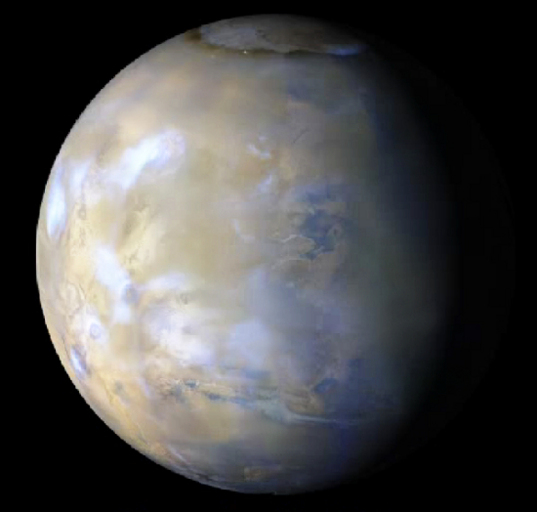
Here’s an interesting post  about clouds forming in low lying areas on Mars: The Mists of Mars – The Planetary Society

The Clouds of Mars

NASA / JPL / Malin Space Science Systems / Bill Dunford
The Clouds of Mars: A composite of global images of Mars taken on
November 29-30, 2013 by the Mars Reconnaissance Orbiter. Water ice
clouds cling to the summits of the major volcanoes, and fill the
giant canyon of Valles Marineris (the long, horizontal feature in the south).