Marooned
By Pink Floyd
With earth imagery from the Int. Space Station
It's
a Whole New Outer Space Out There
The Era of the Reusable
Launch Transport
2026 looks to be the year of the reusable
rocketship. Multiple companies around the
world plan to introduce partially as well
as fully reusable rocket vehicles.
SpaceX
has been the leader in reusability with
over 560 successful landings and 520 reflights
of the Falcon
9 (F9) first stage between 2015 and
early 2026. The F9 has proven that properly
designed and executed reusability significantly
lowers the cost of reaching space. This
lower cost is a key factor to the boom in
the growth of the space industry over the
past several years. Lowering costs further
will enable whole new space based businesses
such as orbital AI data centers.
The F9 is partially reusable. SpaceX is
now developing a fully reusable,
rapid turnaround, two-stage launch
system that can place up to 150 tons of
payload into low earth orbit. The upper
stage is called Starship
and the first stage is the Super Heavy
Booster. At Boca Chica Beach near Brownsville,
Texas the company has built an extensive
production, testing, and launch facility
called Starbase
(pdf). Starship assembly and launch
facilities are currently under construction
on Cape Canveral as well.
By the end of 2025 SpaceX had flown 11
Starship prototypes, making significant
modifications and upgrades from one flight
to another. There were some spectacular
successes as well as failures. Five times
the upper stage made successful soft landings
in the Indian Ocean. And 3 times the boosters
returned to the launch pad after separation
from the upper stages and were successfully
captured by the "chopstick" arms
on the launch tower.
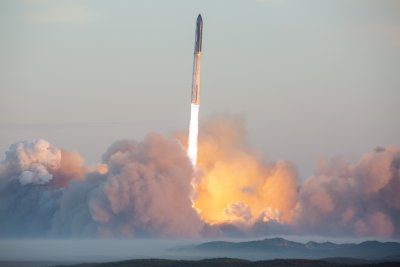
A Starship launches on Nov.18, 2023 for
the second orbital test
flight mission. Credits: SpaceX
In early 2026, SpaceX plans to start test
flying the third major iteration of the
Starship design. While current tests only
aim to reach just short of orbital velocity,
the goal for 2026 is for the Starship to
reach orbit and return to the launch site.
If testing goes well, the Starship system
could become operational by the end of the
year.
Blue
Origin has been flying the fully
reusable suborbital New
Shepard vehicle for several years. It
routinely flies up to 6 people and scientific
projects to 100+ kilometers. The comapny
entered the reusable orbital rocket business
in 2025 with two flights of the New
Glenn rocket, which has a reusable first
stage booster. The booster made a successful
landing on just the second launch.
.. On Nov.13, 2025, Blue Origin launched
a New Glenn rocket for the second time.
It
successfully deployed NASA's ESCAPADE spacecraft
into orbit. The rocket booster
returned after separation from the upper
stage and safely landed on a floating
platform in the Atlantic.
Rocket Lab's Neutron
and Relativity Space's Terran
R each have reusable first stage boosters.
The maiden flights of these could occur
in 2026.
Stoke Space is developing an innovative
fully reusable two stage Nova
vehicle with a medium payload capacity.
They also plan to fly in 2026.
===
Several groups provide round the clock
coverage of Starship activities at Starbase
and in Florida. Check out, for example,
the video reports and webcams at NASASpaceflight.com's
Youtube
Channel, Avid
Space on Youtube, and .
Weekly summary videos reporting on developments
with Starship and other reusable rocket
programscan be found on the What
about it! and Marcus
House Youtube channels.
Cosmic
Perspective relases beautifully
made high-res videos with terrific soundtracks
that hightlight particular events at Starbase.
For example,
SpaceMissionsTM
3D Solar System & Space Missions Simulator from BINARY SPACE
SpaceMissions™
is a 3D Solar System & Space Missions Simulator
from BINARY
SPACE that supports most Earth-centric spacecraft
as well as some selected interplanetary missions such
as MSL (i.e. Curiosity rover), InSight, Rosetta, OSIRIS-REx
and more:
'Travel through our Solar System, visit planets,
comets, asteroids and watch critical maneuvers of
interstellar probes at any time from any desired perspective.'
This application is available for Microsoft® Windows®
10 (10.0.14393 or later) and can be obtained for free
from the Microsoft®
Store.
A scaled-down version of SpaceMissions™ is also available
as a browser-based progressive application: SpaceMissions™
(Web-Edition).
Requirements: Latest versions of Google® Chrome,
Microsoft® Edge (Chromium) or Mozilla® Firefox browsers
and a system that supports WebGL2 with a fast Internet
connection (> 50 Mbps).









_250x141.jpg)
_250x141.jpg)