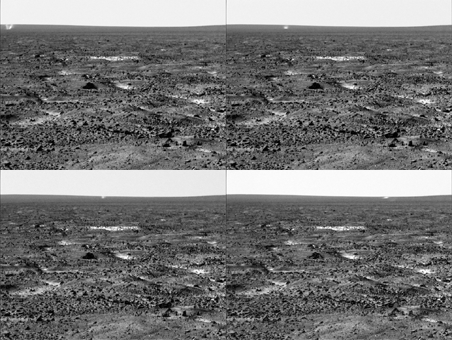
Animation of a sequence of images of a dust devil seen
from the Phoenix Mars Lander (NASA).
Our solar system is not
empty and still. It is a hyperactive place teeming
with natural phenomena and with human and machine activities.
This page (formerly called The Living Space)
attempts to give a sense of this dynamism by providing
samplings of the real-time, or near real-time, space
imagery and data that are available over the web.
Visit this space situation room to find
links to the current position of spacecraft, the latest
images relayed to earth, the current space weather,
remote sensing and weather satellite images of earth,
etc.
Images marked with
are the latest images pulled directly from the source
site.
The
In-Space News
(Note - it's impossible
to list here all the events going on in space
at any one time. So I'll only place the occasional
item that gets my attention. See the Space
News section for links to sites providing
daily space news. - ed.)
Spaceflight101
- "information regarding space flight, up-to-the-minute
coverage of ongoing missions"
Eyes
on the Solar System - "a 3-D environment
full of real NASA mission data. Explore the
cosmos from your computer. Hop on an asteroid.
Fly with NASA's Voyager spacecraft. See the
entire solar system moving in real time. It's
up to you. You control space and time."
Space Activity A pictorial
index to a small
sample of ongoing space exploration
activities.
Each image links to a source of real-time imagery
or data. (Scale & positionings are
fanciful and symbolic.)
Most distant
probes
Pioneer
10/11&
Voyager
1/2 have escaped the gravitational pull of
the solar system and are heading into interstellar
space.
Pioneer 10 and both Voyagers
are still working and transmitting.
Distance from the Sun:
Jan. 25, 2001
Pioneer 10 - 11.42 billion km
(
Light Time: 10 hrs 40min)
Sept. 8,2001
Voyager 1 - 12.31 billion km
Voyager 2 - 9.73 billon
km
Where
is the Space Station?
This map shows where the International
Space Station is at this moment. Track its orbit
with NASA Marshall's J-Track! See
NASA
SkyWatch
for ISS sighting predictions for your location.
Also, see ISS
tracking here.
International
Space Station:
Status & Crew Activies
Real-time
Weather & Remote Sensing
These links in the "Eyes in the Sky" section
are to various weather and remote sensing satellites
that provide a continual stream of earth imagery.
The imagery can include the usual type of TV weathersat
pictures but many RS satellites also provide views
in other wavelengths or in specialized bandwidths
that display unique information. For example, one
satellites might display the current ocean temperatures
and another show the earth's cloud cover.
SpaceCasts
Watch rocket launches and other space activities via
online webcasts. Check the schedules
for the next launch.
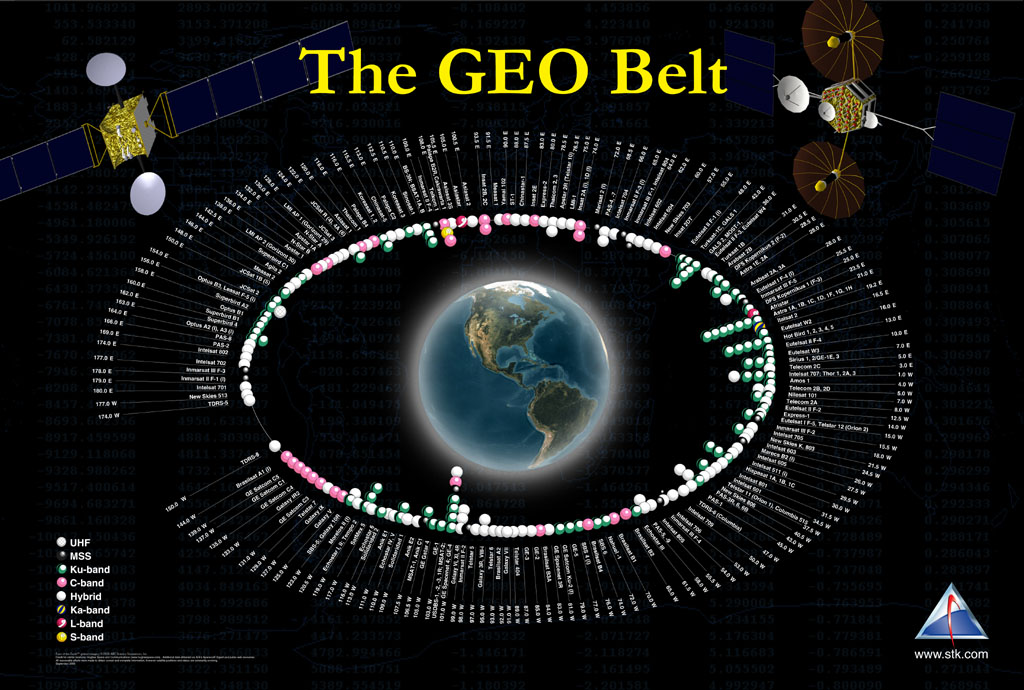
Satellite
Charts
These sites provide information on the current positions
and status of satellites such as those providing telecommunications
services from geostationary orbit.
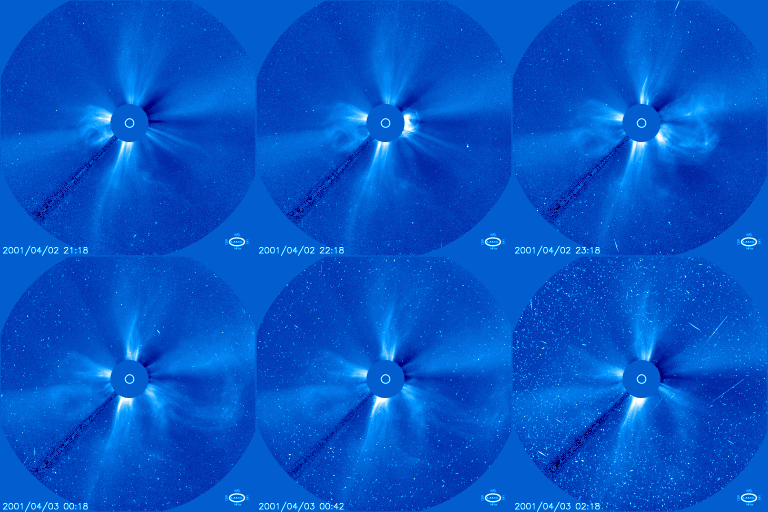
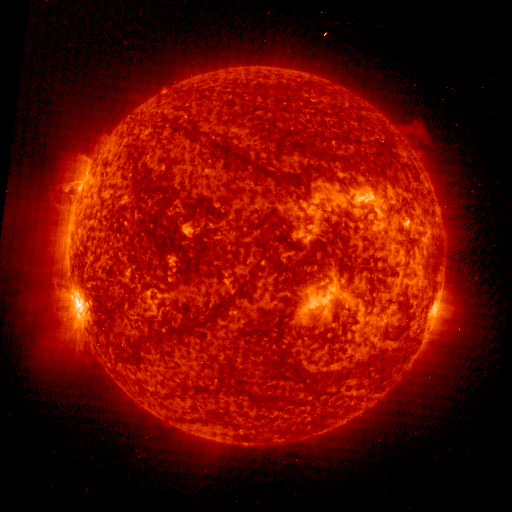
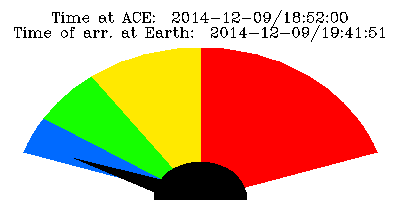
Solar
Stormwatch - Members of the general public
can participate in this project and help solar scientists
spot and track gigantic solar storms, some of which
might impact the earth and cause electrical problems:
Solar scientists need you! Help them spot
explosions on the Sun and track them across space
to Earth. Your work will give astronauts an early
warning if dangerous solar radiation is headed their
way. And you could make a new scientific discovery.