(Credits: Blue
Origin)
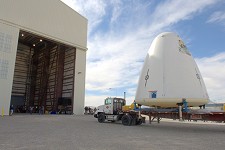
Blue Origin's Goddard prototype VTOL vehicle
returns to the
hangar after a test flight in November 2006.
The table below provides brief descriptions
of a SUBSET of fully and partially
reusable launch and space vehicles (RLSV) projects,
present and past. The table will be updated and
modified periodically as projects come and go.
This list
mostly includes vehicle projects that seem to
be active to some degree. (Active can mean hardware
development at least on the prototype level, announcements
of funding, etc.) Emphasis is on vehicles that
intend to pursue commercial markets such as space
tourism, science/education payloads, high altitude
imaging,etc.
Note: here the term reusable
space vehicle refers to a vehicle,
crewed or not, that is released in space from,
for example, a shuttle or launched on top of an
expendable and then operates in space. When it
is fiinished, it will de-orbit, return to earth,
and be launched again for another mission. For
example, the space station crew rescue vehicle
(CTV), for which the X-38 is a prototype, would
fall in this category. The table focuses on private
development but mentions NASA/Military projects
and some government projects outside the US near
the end.
Air
launched from White Knight 2. Two pilots + 6 passenger
vehicle intended for commercial space tourism.
Passengers
pay $200k each.
Funded by Virgin Galactic. WK2 rolled out late
2008. SS2 rolled out in Dec 2009. Captive carry
& drop tests took place in 2010. First rocket
powered tests expected in early 2011. Passenger
flights in late 2011 or early 2012 timeframe. Links
Modular vehicle used to
win Lunar Lander Challenge 2008
Single stage, vertical
takeoff and landing designs using in house designed
liquid fueled engines. Combine modules to achieve
higher altitudes and larger payloads.
Early designs will be unmanned,
small payload, working up to manned versions. Very
low cost.
Suborbital, booster stage
+ crew capsule, vertical takeoff and landing with
hydrogen peroxide/kerosene engines, with powered
landing. (Goddard uses peroxide only.)
See summary
of Enviro. Impact Report.)
3 or more passenger to
100km, up to 52 flights per year.
Goddard flew for first
time in November 2006. 2 more untethered flights
in 2007. New prototype under construction. Company
intends for a series of prototypes leading to test
flights in 2010, remote control tests in 2011, passenger
flights in 2012 Links
Based on the NASA FDL-7
hypersonic glider concept.
Launched atop a cluster of boosters derived from
the Canadian Arrow rockets.
8 passengers
No info on price
Lost bid for COTS Phase
1 contract. Pursued COTS Phase 2 in 2008 but lost.
Spaceports in Nova Scotia and Ohio in discussion.
Doing scale model flying of Dart Links
2-stage.
First stage winged vehicle takesoff under turbo-fan
power. Rendezvous with tanker to load LOX. Then
fires rocket to 150km where it releases expendable
2nd stage for taking payload to orbit.
Dropped
in favor of Rocketplane XP design for suborbital,
Kistler K-1 for orbital.
Reusable Orion capsule
launched on a two stage Ares 1. First stage uses
version of Shuttle Solid Rocket Booster so it may
be recoverable
Can be used to take a
crew to ISS. Eventually Orion will link up with
lunar modues launched with Ares
5 for travel to the Moon.
Contractors for Ares 1
first stage (ATK) and for Orion (Lockheed-Martin)
were selected in 2006. Contractor for 2nd stage
will be selected in 2007. First crew flights in
2014 time frame.
See Ares
1 and Orion
links.
Reusable
1-stage sub-orbital. Dropped from carrier plane.
Mach 8, altitudes of 250,000 feet.
Fast turnaround,
low costs.
~24 flights in 12months
Canceled
after cost growth due to significant late hardware
changes. These came after the Mars Lander failure
led to review of all major NASA programs. Also,
NASA failed to deliver the Fastrac
engine. Ref
Low
altitude vehicle intended to test low cost reusable
technologies and operations.
Project
of ISAS, the
smaller of the two Japanese space agencies. The
Japan Rocket Society also is assisting with the
project. No flights since 2003. Links
Low altitude vehicle
that tested low cost reusable technologies and operations.
Started as a project
in the Missile Defense program. After 5 flights
transferred to NASA. Demonstrated that a liquid
fueled rocket vehicle could be flown by a small
team and turned around between flights in 26 hours.
All goals met but vehicle later lost when leg failed
to deploy on landing.
Reusable rocketplane dropped
from B-52 during late 1950s through 1960s.
Provide data on how to deal with transition
from atmosphere to near vaccum region and with
the high temperatures on reentry
Very successful program.
Nearly 100 flights made over a decade. Big influence
on the X-20
Dynasoar program and later the shuttle.
See links
for further info.