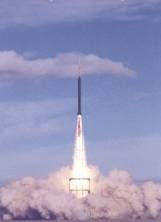
Reaction
Research Society
George Garboden and members of the Reaction
Research Society
built this 500lb rocket that launched a payload to above
an estimated
80km (50mi)* on Nov. 23, 1996.
In this section we cite various advanced experimental
rocketry acheivements such as the highest altitude
reached by an amateur rocket. We also list various
other accomplishments of interest. We also list several
competitions in advanced rocketry.
Note that we don't claim to be an official record
keeper but just want to provide a central database
for this hard to obtain information.
Note that we don't have a absolute, clear-cut definition
of "amateur", "advanced", or "experimental"
rocketry. Generally, if an effort was carried out
by volunteers (even if they work day jobs in rocket
propulsion companies), then it will be included here.
See History
of Experimental Rocketry by Jeff Hove for reference
information on current and past experimental rocketry
groups and projects.
High
Altitude Amateur Rocket Records
72 miles (116 km) -
May 17, 2004 - Black Rock, Nevada - Led by Ky Michaelson
(The
Rocketman), the Civilian
Space eXploration Team flew the 21-foot ‘Go Fast’
rocket using a solid fuel motor. The team included
Derek Deville and Korey Kline of the propulsion company
eAc*.
Further data to be released will put a confidence
interval on the altitude estimate.
The project succeeded in attracting a number of
sponsors, with particular support from Fuscient
and GoFast
Sports.
80km (50mi)- 2-stage booster
with Dart
2nd stage - George Garboden and Reaction
Research Society, Nov.23,1996, Black Rock, Nevada.
First stage reached 27.4km and Mach 4.5.
Note: According to RRS
member Bill Claybaugh, "this altitude was estimated
from a image of the entire Black Rock Desert taken
near peak using known distances between geographic
features". They estimate the max altitude at
52.15 miles with a 50% confidence level, 50.5mi
at 95% C.L.
Project
Stratos launched a rocket from Esrange
on March 17, 2009 that they said broke the European
amateur altitude record by reaching 12.55
12.3 kilometers.
Regarding their record claim, Frank Engelen
project leader of Stratos II sent this information:
"To measure our altitude we made use of an
ETAG, which stands for Esrange Throw Away GPS,
a device normally used when Esrange launches balloons.
This System was supplied by esrange itself, and
considered as a black box for us. Esrange confirmed
that we broke the record http://www.ssc.se/stratos.aspx.
The altitude which is stated in this press release
is above sea level. The launch site itself is
300m above sea level, so we set the record not
at 12,55 but at 12,3 km.
I hope this explains our claim and if there are
still any doubts I could also provide you with
the raw data and/or the master thesis describing
this rocket."
Other Notable
Achievements
Aerospike Engines
First Rocket Flight Powered by a Liquid Fueled Aerospike
Engine - a team of students from Cal State Univ.
at Long Beach and Garvey Spacecraft launched the first
liquid fueled aerospike powered rocket on September
20. See entry
in Adv. Rocketry News - Sept.22.03.
Bi-Propellant Engines
Highest Thrust Amateur Bi-Propellant Engine: A team from Orange County California constructed
an experimental 4000 lb thrust LOX/Methanol engine first
tested on Dec 2 2006 for 24 seconds. Making it the highest
thrust bi-propellant engine for an amateur. The engine
was fired again on April 26 2008 for 33 seconds. Giving
it the highest total impulse for an amateur bi-propellant
engine, 132,000 lb-seconds.
The engine is made from mild steel with an aluminum
injector and relays solely on film cooling to keep the
hardware from over heating and melting.
The engine was designed and built by Richard Ornellas.
Carl Gervais provided technical and logistical support.
Dave Crisalli provided technical support and pyro-ops.
Additional technical support: Dick Blumer, Mike Blumer,
Curtis Nemith and Mike Oakerman Both tests where conducted
at the MTA (Mojave Test Area) in California. Under an
RRS (Reaction
Research Society) sanctioned event.
Next Highest Thrust Amateur Bipropellant engine:
2000lb thrust LOX/Ethanol (75% Ethanol, 25% water) engine
for the Spacefarer X-80, first fired in late 1994, with
a full duration test June 12th 1995. The full duration
test lasted for 52 seconds, making it the longest firing
of an amateur biprop, and also setting the record for
total impulse in an amateur engine, 102,000 lb-seconds.
The engine was designed and built by a core team lead
by Charles Pooley and including Korey Kline (of HyperTEK
fame), Paul Mantilla, and Robert Matevossian. Funding
was provided in part by the National
Space Society, and the work was carried out under
the auspices of the Pacific Rocket Society (PRS)
as part of an effort to send an amateur rocket to an
altitude of 80 kilometers. The test was carried out
at the Mojave
Test Area (Wikimapia)
jointly operated by PRS and the Reaction
Research Society.
Other Notable Amateur Biprops: K. Mark Cavaziel's
1500lb thrust Lox/Ethanol Biprop (RRS), fired at the MTA
on January 23, 2000.
Hybrid
Powered Rockets
* The single project with the largest number of notable
accomplishments in amateur hybrid propulsion is SORAC
(SubOrbital Rocket, Amateur Class), lead by Bill Colburn,
co-inventor of the Urbanski-Colburn valve commonly used
in amateur hybrids. The SORAC team built the largest
amateur hybrid, at 12.6 inches in diameter. This motor
(four were built and flown) had a total impulse of 23,800
lbf-seconds, a thrust of 3400 lbf, and an ISP of 190
seconds, with a burn time of 7 seconds.
"On September 28th of 2003 the SORAC team, under
the leadership of Bill Colburn, flew an 8" diameter,
270 lbm rocket to a height of 40,000 feet, with successful
parachute recovery. Maximum speed is estimated at
Mach 2. The Nitrous Oxide hybrid motor produced 2000
lbf thrust, burning for 7 seconds."
The SORAC team has also developed and tested a coaxial
hybrid motor, in which the fuel grain runs down the
center of the oxidizer tank, giving a shorter overall
length.
* The MARS team
in the UK (MARS is a recursive acronym for MARS Advanced
Rocketry Society) has a number of significant achievements
in hybrid propulsion. Their B4
engine has a design thrust of 2500 Newtons (550 lbf),
but it has been measured as producing thrust up to 3000
Newtons (660 lbf). The B4 engine is a 4 inch diameter
NOX/HDPE hybrid with a theoretical maximum total impulse
of 110,000 Newton-Seconds, though MARS has only run
it to a impulse of 35,000 Newton-Seconds, or about 30%
of fuel consumed. The longest burn on this motor (15
seconds) was a flight from Black Rock, Nevada in September
of 2002, in which it lofted a 24 ft tall 60 Kg rocket
named Diemos Odyssey to an altitude of 25,700 ft above
ground level. This is an altitude record for a European
built amateur hybrid. MARS is continuing to develop
still larger hybrid motors, and plans an eventual space
shot.
* Large hybrid built by Jeff Jakob flew at BALLS 2003.
Reached +25kft. Picture
at rockethigh.com.
(Submitted by Jeff Hove.)
* All-composite hybrid built by Tim Covey flew at BALLS
2002. Reached +55kft. (Submitted by Jeff Hove.)
High Reusability
Punching Holes in the Sky (PHITS), NAR section 565
launched a rocket using commercial
solid motors 28 times in one day on 21st of April 2002,
for a total accumulated altitude of 105,529 ft of altitude.
Details were on the NCR
website The motors were Pro38 manufactured by Cesaroni
Technology Inc.
Advanced
Rocketry Competitions
N-Prize
A low budget (£9,999.99 (sterling), or about US$20K,
cash prize for the first private team to launch a payload
that weighs between 9.99 and 19.99 grams.
NASA
Nano-Satellite Launch Challenge
This is one of NASA's Centennial Challenges competitions.
It was opened in 2010 and at the moment (March 2011)
is still getting organized, e.g. they need a private
partner organization to run it.
The $2M prize requires the following:
"Deliver a payload with a mass of at least 1
kilogram and dimensions of at least 10x10x11 centimeters
to Earth orbit, complete at least one orbit past the
launch site and deliver payloads successfully at least
two times in one week."
The
Carmack 100kft Micro Prize
This competition arose from a discussion on the AROCKET
forum about the difficulty of an amateur team launching
a rocket to 100,000 feet (30km). John Carmack said he
would award $5k to any team that did it and after some
further discussion, the rules were set. Some others
offered to contribute to the purse, which is up to $8k.
Stark
Draper Open Source Rocketry Award - "...This
prize will consist of 3 ounces of gold or the monetary
equivalent going to the next amateur team launching
a vehicle to a height in excess of 200 kilometers.."
- Randall Burns
Previous Competitions:
X
PRIZE
The 10 million dollar X-PRIZE was awarded in
2004 to the Scale
Composites team led by Burt Rutan for the SpaceShipOne
flights. They became
"..the first private team to build and fly
a reusable spaceship capable of carrying three
individuals [or one pilot and the equivalent mass
for two passnegers] on a sub-orbital flight."
X
Prize Cup This was to be an annual event in which teams
would compete in various rocket vehicle related contests
including rocket
racing. However, it was suspended after the third
event in 2007.
The
Official CATS Prize
The Space
Frontier organization sponsored this $250,000
Cheap Access to Space contest: "To be awarded
to the first competitor to deliver our 2 kilogram
payload to 200 km". No team succeeded by the
deadline so the prize was never awarded.
However, the project inspired a number of people,
such as John Carmack and his Armadillo Aerospace,
to form advanced rocket groups and continue to make
progress with increasingly sophisticated rocket
projects. (See Advanced
Rocketry section above.)
Official Boundary
of Space There is no generally agreed on official boundary
for where the atmosphere ends and outer space begins.
In the US the boundary is usually given as 50 miles
when discussing altitude records and so forth. The US
Air Force pushed for a 50 (nautical) mile boundary so
that the X-15 pilots could get astronaut wings.
In the book X-15 Mission Reports, Apogee Books,
p. 9:
"The United States Air Force and NASA reached an
agreement which finally set the lower-limits of Space
at an altitude of 50 miles. By this arbitrary definition
only five months after John Glenn became the first
American to orbit on July 17th 1962, USAF Major Robert
White became the first man to fly into space and subsequently
land back at his point of origin." - Robert Godwin,
editor
However, according to Bill Claybaugh, a former senior
executive at NASA HQ, NASA no longer accepts the 50
mile boundary:
"I specifically asked the then General Consul
of NASA about this '50 mile' stuff and he replied
that since 1968 it has been the official policy of
the United States that it 'takes no position' with
regard to where space begins. This policy--to which
all executive agencies must conform--is a consequence
of the 1967 Space Treaty and subsequent claims by
some nations to sovereign rights to geostationary
orbit. For the record, if one were to check, one will
find that astronaut wings are awarded to those who
reach earth orbit, not 50 nautical miles"
I contacted a representative of the NASA General Consul
about this and she responded with the following:
I am not aware of any "executive order"
stating the U.S. position as to delimitation of outer
space. However, the U.S. has constantly maintained
that there is no need to fix an outer limit to air
space or outer space. Here's a quote from the U.S.
position that was presented by Ambassador Brill at
the Legal Subcommittee meeting of COPUOS [UN
Committee on the Peaceful Uses of Outer Space]
in March 2003.
"At this time, the United States remains convinced
that there is no need to seek a legal definition or
delimitation for outer space. Activities in outer
space and in airspace are flourishing and have raised
no practical need for a definition or delimitation
between the spheres. In the absence of a real need,
any attempt to develop a definition would be ill-advised
as there would be no experience to call upon in agreeing
upon any particular definition or delimitation. The
current framework has served us well and we should
continue to operate under it until there is a demonstrated
need and a practical basis for developing a definition
or delimitation."
In Europe, one typically hears 100km (61.6mi) given
as the standard.
..
Other resources related to the issue of the
boundary to space: