Space-for-All at HobbySpace

Everyone can participate in space
  • HobbySpace
  • About Space-for-All
  • The Sun & Space Weather
  • Aurora & Meteors
Twitter Email RSS
Apr24

“After Earth” discussion event includes Elon Musk, Ray Kurzweil and others

by TopSpacer on April 24, 2013 at 4:17 pm
Posted In: Science and Technology, Space films and videos

In a promotion of Will Smith’s new movie After Earth, Smith participated in a Google+ Hangout moderated by Google’s Ray Kurzweil, and included guests Elon Musk, Alexandra Cousteau, and NASA Astronaut Sunita Williams: SpaceX’s Elon Musk and friends look to the far future: Engage warp drive! – Cosmic Log

Share this:

  • Share
  • Twitter
  • Google +1
  • Tumblr
  • Digg
  • Pinterest
  • StumbleUpon
  • LinkedIn
  • Facebook
  • Print
  • Reddit
  • Email
 Comment 
Apr24

The story of the X-15 suborbital spaceplane

by TopSpacer on April 24, 2013 at 2:42 pm
Posted In: Rockets, Space Systems

Here’s a concise history of the X-15, the first rocketplane to reach space: Suborbital Spaceplane – Greg Kennedy/CitizensInSpace.org

Share this:

  • Share
  • Twitter
  • Google +1
  • Tumblr
  • Digg
  • Pinterest
  • StumbleUpon
  • LinkedIn
  • Facebook
  • Print
  • Reddit
  • Email
 Comment 
Apr24

Winner announced in Alpha Centauri planet naming contest

by TopSpacer on April 24, 2013 at 2:29 pm
Posted In: Astronomy, Contests and Games, Space participation

Nature has this report on the naming of  exoplanets and Pluto’s moons: Moon and planet names spark battle: Company clashes with International Astronomical Union over popular labels for exoplanets – Nature News & Comment

===

Meanwhile, the Uwingu contest to name a planet orbiting Alpha Centauri has a winner:

Uwingu Announces A Name for the Planet Orbiting Alpha Centauri

Space company Uwingu announced the winner of its public engagement contest to solicit and vote on a popular name for the only known planet orbiting the nearest star to the Sun, Alpha Centauri.
Apr. 24, 2013 – BOULDER, Colo. — Space company Uwingu™TM announced the winner of its public engagement contest to solicit and vote on a popular name for the only known planet orbiting the nearest star to the Sun, Alpha Centauri.

The winning name from Uwingu’s competition to select a name for the planet is “Albertus Alauda”. This nomination was entered into Uwingu’s public planet name nomination database last November by Jason Lark, in honor of his late grandfather, Albert Lark. In the citation Lark entered into Uwingu’s database, Lark said, “His name in Latin means Noble or Bright and to praise or extol. I think this is an apt description as my Grandfather was a noble man and bright of character and in this nomination I wish to honour (extol) him.”

12123939-uwingus-efforts-seek-to-better-connect-the-public-to-space-and-astronomy[1]
The second through fifth place name nominations in the competition were Rakhat, Caleo, Amara, and Tiber, with origins in science fiction literature, science, and a man’s love for his fiancée.

Over 1,240 name nominations were received in total. “This really shows that ordinary people like to engage in astronomy and space exploration this new way, and at Uwingu we’re very happy that we could help demonstrate that. We’re also ready to now give people new ways to engage in public sector exoplanet naming” said Uwingu’s CEO Dr. Alan Stern.

Uwingu’s mission is twofold: To help the public better connect to space and the sky, and to create a new kind of grant fund for space researchers and educators using proceeds from our web site. Uwingu’s name means sky in Swahili. Uwingu’s web site can be found at www.uwingu.com.

Uwingu Fund grant dollars from the Alpha Centauri planet naming competition will be used to help space educators and educator projects.

 ####

About Uwingu: Uwingu (which means “sky” in Swahili, and is pronounced “oo-wing-oo”)

was formed by a team of leading astronomers, planetary scientists, former space program executives, and educators. The company includes space historian and author Andrew Chaikin, space educator Dr. Emily CoBabe-Ammann, citizen science leader Dr. Pamela Gay, author and former museum science director Dr. David Grinspoon, planet hunter Dr. Geoff Marcy, planetary scientist and aerospace executive Dr. Teresa Segura, planetary scientist and former NASA science boss Dr. Alan Stern, planetary scientist and CEO of the Planetary Science Institute, Dr. Mark Sykes, former Executive Director of the Planetary Society Dr. Louis Friedman, and space artists Jon Lomberg and Dan Durda. In September, Uwingu successfully concluded one of the 25 largest Indiegogo crowd-funding campaigns ever to launch an ongoing series of public engagement projects. Visit Uwingu’s web site at www.uwingu.com to learn more.

Share this:

  • Share
  • Twitter
  • Google +1
  • Tumblr
  • Digg
  • Pinterest
  • StumbleUpon
  • LinkedIn
  • Facebook
  • Print
  • Reddit
  • Email
 Comment 
Apr24

National Space Society adds four to leadership team

by TopSpacer on April 24, 2013 at 2:07 pm
Posted In: Activism

An announcement from the National Space Society:

National Space Society Adds to its Leadership Team

 Washington, DC — April 24, 2013 – The National Space Society announces the selection of four new additions to its leadership team:  Dr. Stanley G. Rosen to the newly created position of Vice Chairman of the Society’s Board of Directors, Bruce Pittman as Senior Vice President and Senior Operating Officer, Dr. Paul Werbos as Executive Vice President and Chair of the Policy Committee, and Craig Andrew Max IV as Assistant Secretary.

In announcing the appointments, Kirby Ikin, Chairman of the Board welcomed the experience these officers will bring to the Society, stating  ”The appointments will enable NSS to operate more efficiently and be better able to carry out its mission of providing grass roots support for space exploration, space settlement, and utilization of space resources down on Earth.”

Dr. Rosen, whose special role will be to coordinate the efforts of NSS senior leaders, is currently a Professor at the Department of Defense’s Defense Acquisition University.  Formerly be was a consultant with Toffler Associates, Director of Strategic Development and Integration for Boeing Satellite Systems, and Strategic Planning Director for the Hughes Defense Systems and Hughes Space and Communications organizations.  His previous work included scientific, engineering, program management, and strategy and policy development positions with the U.S. Air Force, and time on the staff of the Committee on Science and Astronautics of the U.S. House of Representatives.

Bruce Pittman currently serves as Director of Flight Projects and Chief System Engineer at the Space Portal at NASA Ames Research Center.  In 2011, NASA awarded him the Exceptional Public Service Medal for “exceptional leadership in pioneering the development of commercial space for public benefit.”  He was a founder and member of the startup team in a number of early growth companies including Space Hab, Kistler Aerospace, New Focus, Product Factory, Prometheus II Ltd., and Industrial Sound and Motion.  He is a member of the Executive Committee of the Space Investment Summit Coalition.

Dr.  Werbos is the Program Director in the Office of Emerging Frontiers in Research & Innovation at the National Science Foundation (NSF).  Since 1988, he has also led research in a variety of other NSF areas, including fuel cell and electric vehicles, emerging technologies, cyber systems, and the sustainability part of NSF Interdisciplinary Research.  He is a Fellow of the Institute of Electrical and Electronics Engineering (IEEE), and the International Neural Network Society (INNS).  He is a winner of the IEEE’s Neural Networks Pioneer Award and of the INNS’s 2011 Hebb Award.  He is also serving on boards of NSS, Millennium Project, Lifeboat Foundation, and IEEE Energy Policy Committee.

Craig Max is an attorney with the law firm of Vanderpool, Frostick & Nishanian, P.C., with offices in Manassas, Fredericksburg, and Woodbridge,Virginia.  Specializing in tax planning, including working with nonprofits, he also is a Certified Public Accountant and Board-certified as a Trust and Estate Practitioner by the International Society of Trust and Estate Practitioners.  He has been designated a Fellow of the American Academy of Financial Management and named a Top Attorney by Northern Virginia magazine; a SmartCPA and a LegalElite by SmartCEO magazine; and a SmartCPA and a Legal Elite by Virginia Business magazine.  He is the author of numerous legal and accounting publications and holds an appointment as an Assistant Professor at the University of Maryland.

Fuller biographies of these and other NSS officers may be found on the NSS website www.nss.org/about/leadership.html.

#   #   #

About the National Space Society:
NSS is an independent, educational, membership, non-profit organization dedicated to the creation of a spacefaring civilization. NSS is widely acknowledged as the preeminent citizen’s voice on space, with over 8,000 members and supporters, and over 50 chapters in the United States and around the world. The Society publishes Ad Astra magazine, an award-winning periodical chronicling the most important developments in space. To learn more, visit www.nss.org.

Share this:

  • Share
  • Twitter
  • Google +1
  • Tumblr
  • Digg
  • Pinterest
  • StumbleUpon
  • LinkedIn
  • Facebook
  • Print
  • Reddit
  • Email
 Comment 
Apr24

Three years of the Sun in four minutes

by TopSpacer on April 24, 2013 at 2:34 am
Posted In: Multiple media, Solar Science

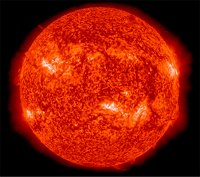
NASA releases a video showing a time lapse sequence of solar images taken over three years by the  Solar Dynamics Observatory (SDO). There are 2 images per day:

  • Three Years of SDO Images – NASA
  • Goddard Multimedia Item 11255 – Three Years of SDO Images

Three Years of SDO Images
NASA 04.22.13:  In the three years since it first provided images of the sun in the spring of 2010, NASA’s Solar Dynamics Observatory has had virtually unbroken coverage of the sun’s rise toward solar maximum, the peak of solar activity in its regular 11-year cycle. This video shows those three years of the sun at a pace of two images per day.

SDO’s Atmospheric Imaging Assembly captures a shot of the sun every 12 seconds in 10 different wavelengths. The images shown here are based on a wavelength of 171 angstroms, which is in the extreme ultraviolet range and shows solar material at around 600,000 kelvins (about 1.08 million F). In this wavelength it is easy to see the sun’s 25-day rotation as well as how solar activity has increased over three years.

During the course of the video, the sun subtly increases and decreases in apparent size. This is because the distance between the SDO spacecraft and the sun varies over time. The image is, however, remarkably consistent and stable despite the fact that SDO orbits Earth at 6,876 mph and Earth orbits the sun at 67,062 mph.

Such stability is crucial for scientists, who use SDO to learn more about our closest star. These images have regularly caught solar flares and coronal mass ejections in the act, types of space weather that can send radiation and solar material toward Earth and interfere with satellites in space. SDO’s glimpses into the violent dance on the sun help scientists understand what causes these giant explosions — with the hopes of some day improving our ability to predict this space weather.
composite SDO image of sun from April 2012-April 2013
This image is a composite of 25 separate images spanning the period of April 16, 2012, to April 15, 2013. It uses the SDO AIA wavelength of 171 angstroms and reveals the zones on the sun where active regions are most common during this part of the solar cycle.

Share this:

  • Share
  • Twitter
  • Google +1
  • Tumblr
  • Digg
  • Pinterest
  • StumbleUpon
  • LinkedIn
  • Facebook
  • Print
  • Reddit
  • Email
 Comment 
Apr24

OK Go go after the music in the Aurora Borealis

by TopSpacer on April 24, 2013 at 2:25 am
Posted In: Space Music, Space Radio, Space Science

The band OK Go and a group of other artists went to northern Sweden to observe and incorporate the Aurora Borealis into a music video: OK Go and Collaborators Capture the ‘Sound’ of the Northern Lights – Wired Design/Wired.com.

This  included radio sounds created by the Aurora. For more about such “natural radio music”, see   the HobbySpace Natural Space Radio and Natural Space Music sections, which include links to Stephen McGreevy (mentioned in the article) and others involved in such activities.

Share this:

  • Share
  • Twitter
  • Google +1
  • Tumblr
  • Digg
  • Pinterest
  • StumbleUpon
  • LinkedIn
  • Facebook
  • Print
  • Reddit
  • Email
 Comment 
Apr24

Copenhagen Suborbitals: Capsule update

by TopSpacer on April 24, 2013 at 2:03 am
Posted In: Activism, DIY space, Rockets

Copenhagen Suborbitals makes progress on the boilerplate test version of their capsule  design: Capsule Assembly, Cranes and Azerbaijan – Wired Science/Wired.com

TDSII_boilerplate_assembly02_660_300x268

Share this:

  • Share
  • Twitter
  • Google +1
  • Tumblr
  • Digg
  • Pinterest
  • StumbleUpon
  • LinkedIn
  • Facebook
  • Print
  • Reddit
  • Email
 Comment 
Apr24

A surprise meteorite in Connecticut and a fireball in Argentina

by TopSpacer on April 24, 2013 at 12:52 am
Posted In: Space Science

A Connecticut family had a celestial visitor drop in on them:  Meteorite Crashes Through Roof of a House in Connecticut – Universe Today

===

In Argentina a fireball gave an added flare to a rock concert:  A suspected meteor flash briefly transforms night to day in Argentina – Cosmic Log

Share this:

  • Share
  • Twitter
  • Google +1
  • Tumblr
  • Digg
  • Pinterest
  • StumbleUpon
  • LinkedIn
  • Facebook
  • Print
  • Reddit
  • Email
 Comment 
Apr23

Space policy roundup

by TopSpacer on April 23, 2013 at 6:31 pm
Posted In: Space Policy

Congressional hearings on proposed NASA 2014 budget start this week:

  • A busy week of NASA hearings – Space Politics
  • Space Policy Events for the Week of April 21-26, 2013 – SpacePolicyOnline

A number of technical, financial and political hurdles must be overcome before NASA sends a probe to nudge an asteroid into lunar orbit.  To catch a planetoid – The Space Review.

Bill Gerstenmaier, NASA’s Associate Administrator for Human Exploration and Operations, has been talking at various events about the asteroid capture concept: Gerstenmaier Elucidates Asteroid Return Strategy – SpacePolicyOnline.com

Res Communis post the latest collection of space and aviation law, regulation and policy links: Library: A Round-up of Reading.

Update:  Marcia Smith reviews today’s Senate hearing: Stafford Argues for Moon as Next Human Spaceflight Destination – SpacePolicyOnline.com.

And Jon Goff of Altius Space gives his views on some of the testimony given: Hobgoblins – Selenian Boondocks.

**************************

Shop Amazon – Best Selling Products – Updated Every Hour

Share this:

  • Share
  • Twitter
  • Google +1
  • Tumblr
  • Digg
  • Pinterest
  • StumbleUpon
  • LinkedIn
  • Facebook
  • Print
  • Reddit
  • Email
 Comment 
Apr23

The Great Moonbuggy Race attracts several hundred competitors

by TopSpacer on April 23, 2013 at 6:25 pm
Posted In: Contests and Games, Education, Space Systems

NASA Marshall Spaceflight Center this week will host the 20th Annual Great Moonbuggy Race ®, April 25 – 27, 2013: NASA’s Great Moonbuggy Race draws international field of 600 competitors to Huntsville – al.com

Updates will be posted at NASA Marshall Center (MOONBUGGYRACE) on Twitter.

Here is a video from last year’s event:


**************************

Shop Amazon – Best Selling Products – Updated Every Hour

Share this:

  • Share
  • Twitter
  • Google +1
  • Tumblr
  • Digg
  • Pinterest
  • StumbleUpon
  • LinkedIn
  • Facebook
  • Print
  • Reddit
  • Email
 Comment 
Apr23

Videos: Planetary Society event at IAA Planetary Defense Conf.

by TopSpacer on April 23, 2013 at 5:02 pm
Posted In: Activism, Education, Space Science

On Wednesday of last week’s 2013 IAA Planetary Defense Conference held at Northern Arizona University in Flagstaff., the Planetary Society organized a public event. It was hosted by Bill Nye the Science Guy and Planetary Society CEO and included Geoff Notkin and Steve Arnold, the  Science Channel’s Meteorite Men. Below are videos of the event

Part 1:

What a night! More than 900 people gathered at Northern Arizona University on April 17, 2013 to celebrate science and people who have dedicated themselves to saving humanity from a killer asteroid. Master of Ceremonies Bruce Betts, the Planetary Society’s Director of Projects, gets the evening started, and is then joined by Planetary Radio host Mat Kaplan for a raucous What’s Up! recording session.

Part 2:

The 2013 PDC public event welcomes the co-star of the Science Channel’s popular reality show to the Northern Arizona University stage. Notkin describes his worldwide search for space rocks, and why they fascinate him.

Part 3:

The Planetary Society’s Director of Projects served as MC for the exciting public event at this year’s PDC. It was the perfect venue for Bruce to announce the winners in the latest round of Shoemaker Near Earth Object grants from the Society. These awards enable dedicated amateur astronomers and smaller professional observatories to vastly improve their ability to discover and track asteroids and comets that pose a threat to Earth.

Part 4:

The Planetary Society’s CEO was a wildly popular speaker at the PDC public event on April 17, 2013. Here’s his presentation to over 900 fans on the campus of Northern Arizona University in Flagstaff

Part 5:

Moderator Mat Kaplan of Planetary Radio leads a lively and inspiring conversation in the grand finale of the PDC public event. Four outstanding young leaders in the planetary defense community join Bill and Mat on stage:

-Flight Dynamics Engineer Brent Barbee of the Goddard Space Flight Center
-NEOWISE Principal Investigator Amy Mainzer of JPL
-Applied Physics Research Scientist Cathy Plesko of Los Alamos National Lab
-Assistant Professor of Physics and Astronomy David Trilling of NAU

Share this:

  • Share
  • Twitter
  • Google +1
  • Tumblr
  • Digg
  • Pinterest
  • StumbleUpon
  • LinkedIn
  • Facebook
  • Print
  • Reddit
  • Email
 Comment 
Apr23

Virginia elementary/middle school is building a Cubesat

by TopSpacer on April 23, 2013 at 4:03 pm
Posted In: Amateur/Student Satellite, Education

The low cost CubeSat approach to satellite design is growing rapidly in popularity and over 75 Cubesats have reached space already. Most of these have come from colleges, universities and small companies. Now even a K-8 school is building one: Young students aim to be among first to launch small satellite – SlashGear.

Students at St. Thomas More Cathedral School in Arlington, VA are aiming to be a part of a milestone. The school is looking to become the first K-8 school to launch a “CubeSat” satellite into space. The proposed satellite that the students will build would be four inches long in all directions and would weigh around three pounds.

The project has to be approved by NASA, but if the school gets clearance, the satellite will have a planned launch date sometime later in 2014. The CubeSat satellite that St. Thomas More students have planned will be designed to take photographs and temperature readings, and have them beamed back to the school on Earth.

Share this:

  • Share
  • Twitter
  • Google +1
  • Tumblr
  • Digg
  • Pinterest
  • StumbleUpon
  • LinkedIn
  • Facebook
  • Print
  • Reddit
  • Email
 Comment 
Apr22

Space Apps Challengers in Canada + A better BeagleBone embeddable processor

by TopSpacer on April 22, 2013 at 8:03 pm
Posted In: DIY space, Software, Space participation

Chuck Black reports on Canadian teams competing in the 2013 International Space Apps Challenge (see earlier post): Our Space Future on Display: The 2013 Int’l Space Apps Challenge -| The Commercial Space Blog.

===

Ed Wright spotlights the BeagleBone open-source single-board microcomputer for embedded applications, which will be presented at the upcoming First Space Hacker Workshop in Silicon Valley: Next-Generation BeagleBone is $45 – CitizensInSpace.org

Share this:

  • Share
  • Twitter
  • Google +1
  • Tumblr
  • Digg
  • Pinterest
  • StumbleUpon
  • LinkedIn
  • Facebook
  • Print
  • Reddit
  • Email
Comments Off
Apr22

Video: The Mars One astronaut selection program briefing

by TopSpacer on April 22, 2013 at 7:20 pm
Posted In: Activism, Living in Space, Space Settlement

The Mars One organization had a press conference event in New York City today to talk about the selection of Applicants for their plan to put a settlement on Mars. The panel included:

  • Bas Lansdorp, Co-Founder and CEO, Mars One
  • Gerard ‘t Hooft, Nobel laureate and Ambassador of Mars One
  • Norbert Kraft, Chief Medical Officer, Mars One
  • Grant Anderson, Sr. VP Operations, Chief Engineer and Co-Founder, Paragon Space Development Corporation
  • Bryan Versteeg, Mission Concept Artist, Mars One

The event was  moderated by Emily Lakdawalla, Senior Editor at the Planetary Society.

Update: Here is a press release from Mars One:

Mars One starts its search for the first humans on Mars

NEW YORK, Monday, 22nd April 2013 – Mars One is happy to announce the launch of its astronaut selection program today. The search has begun for the first humans to set foot on Mars and make it their home.

Mars One invites would-be Mars settlers from anywhere in the world to submit an online application via apply.mars-one.com.

This online application will be the first of the four rounds that together make the Mars One selection procedure. Round One will run for over five months and end on 31st August 2013. Applicants selected at the end of this round will include the first crew that will land on Mars in 2023. Mars One selection committees will hone the search for the first crew in three subsequent rounds and further training.

“We are very excited about launching the selection program. Round One is where we open the doors to Mars for everyone on Earth. This is an international mission and it is very important for the project that anyone anywhere can ask themselves: Do I want this? Am I ready for this? If the answer is yes then we want to hear from you,” said Bas Lansdorp, co-founder of Mars One.

In the last year Mars One received 10,000 messages from prospective applicants from over 100 countries. Mars One expects an unprecedented number of applications and even more internet users visiting the application website to support their favorite candidates.

Applicants are given the choice of publicly sharing and promoting their application page. While Mars One experts will choose which candidates progress to Round 2, everyone will have the opportunity to know the aspiring settlers and give them their vote of confidence.

Applicants will pay a small administration fee that varies across nations according to their per capita GDP. The variable fee makes the program equally accessible for applicants from all nations and also reduces the number of insincere entries.

“For this mission of permanent settlement we are more concerned with how well each astronaut lives and works with others and their ability to deal with a lifetime of challenges.”

“Gone are the days when bravery and the number of hours flying a supersonic jet were the top criteria,” said Norbert Kraft, Mars One’s Chief Medical Director and former NASA senior researcher.

“For this mission of permanent settlement we are more concerned with how well each astronaut lives and works with others and their ability to deal with a lifetime of challenges.”

Throughout the astronaut selection program, Mars One will select applicants who have good physical and mental health and show five key character traits: Resilience, Adaptability, Curiosity, Ability to trust others, and Creativity/Resourcefulness.

In the last stage when 24-40 candidates have been fully trained and qualified, the final decision of choosing the first settlers will be decided by an audience vote.

“In a 1000 years, everyone on Earth will still remember who the first humans on Mars were, just like Neil Armstrong has etched in our memories forever. This makes the selection of the first crew to a different planet a very important election; in my opinion more important than most elections. We hope the whole world will join Mars One in our democratic search of the envoys of mankind to Mars, ” Lansdorp said.

About Mars One
The Mars One Foundation is a not-for-profit organisation that will send humans to Mars in 2023 to establish the first permanent settlement outside Earth. Before the first settlers land on Mars a self-sustaining habitat will be set up with help of rovers and more settlers will follow every two years. A realistic mission plan has been designed using only existing technology available through the private space industry. The first footprint on Mars will fascinate and inspire generations; it is this public interest that will help finance this human mission to Mars.

Share this:

  • Share
  • Twitter
  • Google +1
  • Tumblr
  • Digg
  • Pinterest
  • StumbleUpon
  • LinkedIn
  • Facebook
  • Print
  • Reddit
  • Email
Comments Off
Apr22

Astronaut Don Pettit and photography from the ISS

by TopSpacer on April 22, 2013 at 7:14 pm
Posted In: Eyes in the Sky, Living in Space

In this interview, NASA astronaut Donald Pettit talks about how he and his “fellow Expedition 30/31 crew members captured more than a half a million photographs of Earth from aboard the International Space Station.”

Share this:

  • Share
  • Twitter
  • Google +1
  • Tumblr
  • Digg
  • Pinterest
  • StumbleUpon
  • LinkedIn
  • Facebook
  • Print
  • Reddit
  • Email
Comments Off
Apr22

The Space Show this week

by TopSpacer on April 22, 2013 at 3:00 pm
Posted In: Activism, SpaceCasts

The list of programs on The Space Show this week:

1. Monday, April 22, 2013, 2-3:30 PM PST (5-6:30 PM EST, 4-5:30 PM CST): No show today as I am teaching my UND Space Studies class.

2. Tuesday, April 23 2013 2013, 7-8:30 PM PST (10-11:30 PM EST, 9-10:30 PM CST): No program as I am still in Los Angeles. The Open Line show planned for tonight will be rescheduled as soon as possible.

3. Friday, April 26, 2013, 9:30-11 AM PST (11:30- 1 PM CST, 12:30PM-2:00 PM EST): We welcome CHUCK KILLIAN to discuss the The Mars Society‘s MDRS [Mars Desert Research Station] Mission Support & Planning project.

4. Sunday, April 27, 2013, 12-1:30 PM PST (3-4:30 PM EST, 2-3:30 PM CST). We welcome MARC FUSCO to discuss his graduate space thesis regarding the JFK – Nixon space policies, commercial space and more.

See also:
/– The Space Show on Vimeo – webinar videos
/– The Space Show’s Blog – summaries of interviews.
/– The Space Show Classroom Blog – tutorial programs

The Space Show is a project of the One Giant Leap Foundation.

Share this:

  • Share
  • Twitter
  • Google +1
  • Tumblr
  • Digg
  • Pinterest
  • StumbleUpon
  • LinkedIn
  • Facebook
  • Print
  • Reddit
  • Email
Comments Off
Apr21

Space policy roundup: JWST cost/schedule realities + Asteroid return strategy + Space at DC forum

by TopSpacer on April 21, 2013 at 7:22 pm
Posted In: Space Policy

John Kelly is very skeptical that the James Webb Space Telescope will meet its cost and and schedule goals: Space telescope cost, schedule unrealistic – Florida Today

===

Marcia S. Smith posts a report on comments in the past week by Bill Gerstenmaier, NASA’s Associate Administrator for Human Exploration and Operations, on the rationale behind the NASA interest in an asteroid capture program: Gerstenmaier Elucidates Asteroid Return Strategy – SpacePolicyOnline.com.

===

Robert Walker, former chair of a House science committee,  and Scott Pace, director of George Washington University’s Space Policy Institute, recently spoke on space issues at a forum at the Washington Council on Foreign Relations

  • Space Policy Vets Recommend Global Moon Initiative – Aviation Week
  • Not About Chechens: ‘Future of U.S. Space Policy’ – James Fallows/The Atlantic

Share this:

  • Share
  • Twitter
  • Google +1
  • Tumblr
  • Digg
  • Pinterest
  • StumbleUpon
  • LinkedIn
  • Facebook
  • Print
  • Reddit
  • Email
Comments Off
Apr21

AMSAT & ISS amateur radio news

by TopSpacer on April 21, 2013 at 5:45 am
Posted In: Amateur/Student Satellite, Space Radio

Go to AMSAT News for the latest headlines about developments in amateur and student satellites and for updates about amateur radio on the ISS.

ANS 111 Weekly AMSAT Bulletin – April 20, 2013:
* April 19 Soyuz-2-1B Launch Plans Cubesat Deployment on April 21
* April 21 Antares Launch to Orbit Three PhoneSat Cubesats
* April 25 China CZ-2D to Launch TURKSAT-3USAT Linear Transponder
* May 3 Vega Launch from Kourou to Orbit ESTCube-1 CubeSat
* AMSAT-NA Board of Directors Nominations Solicited
* ARISS School Contacts
* Order AMSAT/TAPR Dayton Banquet Tickets in the AMSAT Store
* Registration for the SA AMSAT Space Symposium is Now Open
* Inspiration and Success: The Story Behind N1LF’s 1st Satellite QSO
* RockOn 2013 University Rocket Science Workshop
* Satellite Shorts From All Over

Share this:

  • Share
  • Twitter
  • Google +1
  • Tumblr
  • Digg
  • Pinterest
  • StumbleUpon
  • LinkedIn
  • Facebook
  • Print
  • Reddit
  • Email
1 Comment
Apr21

Int. Space Apps Challenge + Robonaut 2 Challenge + A need for big challenges too

by TopSpacer on April 21, 2013 at 5:41 am
Posted In: Contests and Games, Education, Space participation

The International Space Apps Challenge is underway this weekend.

The International Space Apps Challenge is an international mass collaboration focused on space exploration that takes place over 48-hours in cities around the world. The event embraces collaborative problem solving with a goal of producing relevant open-source solutions to address global needs applicable to both life on Earth and life in space. NASA is leading this global collaboration along with a number of additional government collaborators and 100+ local partner organizations.

See the 50 challenges here.  And the locations around the world where the teams are competing.

===

NASA Robonaut Challenge is also happening this month. It challenges programmers to code a couple of particularly useful tasks for the humanoid-like Robonaut 2 on the ISS.

===

Ed Wright endorses the modest sized challenge competitions like those above but says NASA should also continue to support important major challenges with big prizes as they did with the Lunar Lander Challenge competition: Robonaut Programming Challenge – CitizensInSpace.org


Share this:

  • Share
  • Twitter
  • Google +1
  • Tumblr
  • Digg
  • Pinterest
  • StumbleUpon
  • LinkedIn
  • Facebook
  • Print
  • Reddit
  • Email
2 Comments
Apr21

TV sci-fi in a rut + More on exoplanet naming

by TopSpacer on April 21, 2013 at 12:43 am
Posted In: Solar Sci-Fi, Space participation, Space TV

The creator of Babylon 5 talks about the state of TV science fiction: Babylon 5′s J. Michael Stracynski explains why most TV scifi is awful – i09.com

===

Alan Boyle revisits the exoplanet naming controversy: Who gets to name alien planets? – Cosmic Log

(See also See earlier posts here and here.)

Share this:

  • Share
  • Twitter
  • Google +1
  • Tumblr
  • Digg
  • Pinterest
  • StumbleUpon
  • LinkedIn
  • Facebook
  • Print
  • Reddit
  • Email
1 Comment
  • Page 9 of 36
  • « First
  • «
  • 7
  • 8
  • 9
  • 10
  • 11
  • »
  • Last »
I Dream of Space
Attend the first ever Space Hacker Workshop for Suborbital Experiments in Silicon Valley May 4 and 5

Try the Satellite Tracking Tool from BINARY SPACE hosted here at HobbySpace.

Check out Virtual Space 3D reports and other videos on the HobbySpace Youtube Channel.

RSS NewSpace Watch

  • Bezos and Florida disagree over taxes + Globalstar completes refinancing
  • Tethers Unlimited gets 4 NASA SBIR contracts for novel space technologies
  • 6th IAASS Space Safety Conference 2013 - Montreal, Canada
  • Dream Chaser unwrapped
  • Space Tech Expo - Day 1
  • Bigelow/NASA and the opening of deep space to private ventures
  • New California bill to limit liability for space tourism hardware builders and suppliers
  • Rocket flight in Mojave airspace Tuesday + NewSpace taking over + Dave Mackay interview
  • NASA and Bigelow Aerospace to hold briefing on study of commercial deep space exploration
  • Science fiction film "Newcomers" to use XCOR Lynx

Recent Comments

  • TopSpacer on Sci-Tech: Independent tests of Rossi E-Cat LENR systems show “anomalous heat energy production”
  • Patrick on Sci-Tech: Independent tests of Rossi E-Cat LENR systems show “anomalous heat energy production”
  • Jay Kusnetz on Sci-Tech: Independent tests of Rossi E-Cat LENR systems show “anomalous heat energy production”
  • TopSpacer on Sci-Tech: Independent tests of Rossi E-Cat LENR systems show “anomalous heat energy production”
  • TopSpacer on Sci-Tech: Independent tests of Rossi E-Cat LENR systems show “anomalous heat energy production”

Recent Posts

  • Video: NASA Lunabotics Mining Competition at KSC
  • Meteorites in auction include one from Mars
  • SETI Hangout: “Are we ready to build a spaceship to explore nearby stars? “
  • Cosmosphere to display preservation work on Apollo engines recovered by Bezos Expeditions
  • Video: “Europa Report” trailer

Categories

  • Activism
  • Amateur/Student Satellite
  • Astronomy
  • Contests and Games
  • DIY space
  • Education
  • Events
  • Exoplanets
  • Eyes in the Sky
  • General
  • History
  • In Space Infrastructure
  • Living in Space
  • Multiple media
  • Near Space
  • Rocketry
  • Rockets
  • Satellite Watching
  • Science and Technology
  • SETI
  • Shopping
  • Simulators
  • Software
  • Solar Sci-Fi
  • Solar Science
  • Space Arts
  • Space books
  • Space camps & hands on sims
  • Space Collecting
  • Space films and videos
  • Space humor
  • Space Models
  • Space Music
  • Space participation
  • Space Policy
  • Space Radio
  • Space Science
  • Space Settlement
  • Space Systems
  • Space TV
  • SpaceCasts
  • Spaceflight & Parabolic Flight
  • The Moon
  • Uncategorized

Archives

  • May 2013
  • April 2013
  • March 2013
  • February 2013
  • January 2013
Photo To Space
NASA Toys and Gifts
XCOR Aerospace
Best Aviation Jobs
Buck A Day Pharmacy
cash for gold
Corporate Office Finder
Custom Printed Promotional Products
LED Flashlights
Read How
san diego auto transport
Website Stats
Worldwide free shipping

©2013 Space-for-All at HobbySpace | Powered by WordPress with Easel | Subscribe: RSS | Back to Top ↑

loading Cancel
Post was not sent - check your email addresses!
Email check failed, please try again
Sorry, your blog cannot share posts by email.